30 Years of change in images
"In the past, taking a photo was a very serious affair. People came to the studio and either stood upright in front of the camera or sat still. Now, customers have all kinds of poses, just like actors." In Chen Fengchun's memory, people's expressions when facing a camera have undergone enormous changes over the decades.
One anecdote now seems like a joke: "A young couple came in for wedding photos. The photographer went into the old-fashioned big camera with a cloth over his head, but found that he could not see the bride. He came out and found that she had fainted from nerves! Meanwhile, the groom, his plastic flowers clenched in his fist, was staring rigidly ahead, unaware of what had happened to his bride..."
 |
|
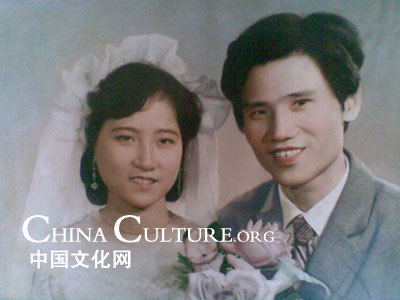
A wedding photo took in the 1980s. |
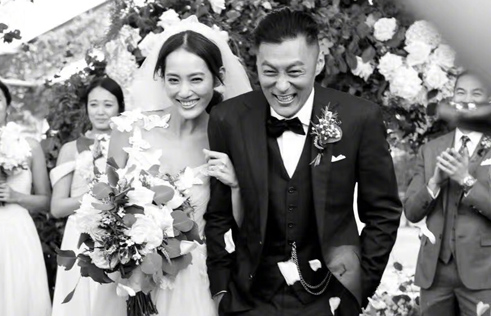
Chen Fengchun said that the most obvious change is in wedding photos. "We can see a clear evolution in the stances of the men and women: in the early photos, the man would sit on a bench with the woman standing behind or alongside him; later, as ideas of equality progressed, many of the photographs posed the two side by side; after the reform and opening-up, some men 'dared' put their arms around their partner; later, the man might even stand behind the woman. Now look at wedding photography -- the woman is the 'leading character' in the photos... These positional changes are an unmistakable reflection of the tremendous changes in human society."
There have also been tremendous changes in the decoration of photos. Chen Fengchun said most former graduation photos carried slogans like "graduation memento" or "great expectations"; wedding photos would carry mottoes like "revolutionary friendship", and "pull together in times of trouble" ...
Later, flower images began to appear on photos, particularly sought out and admired by young people. Then, after color photos appeared, fashions in color and dress began to change. By the late 1980s, as the "foolproof" camera grew in popularity, more and more people would go outdoors to take their pictures themselves. At that time, albums were filled with photos of picnics taken in parks and in the open air crowded with groups of happy and free expressions.
By the mid and late 1990s people had started to come back to the photo studio in search of so-called "artistic photos "; gradually series of photos would be gathered into albums with colorful text and romantic expressions like "emotion" and "love" decorating the pages... Now, Chen Xu spends more time on photography. He says that normally people come to photo studios for albums. A child's album includes at least 12 photos, and nowadays children are skilled at posing in front of a camera.
According to Chen Fengchun everyone loves beauty, and those who love beauty love taking photos. Of course, not all photos are taken from a love of beauty. But for keepsakes, for friendship, for love, for cherishing... In short, to remember what people have experienced and record it for posterity.
On the subject of reasons for photo-taking, Chen Fengchun is very emotional. He says in the past people would take photos simply to keep as souvenirs, such as for graduations, friendships, family partings, wedding, gatherings, tourism... So early pictures were usually inscribed "somewhere, for a souvenir". Taking pictures became a more personal form of family entertainment as cameras grew in popularity, which was a major change.
The latest "artistic photos for stars" and "natural albums" have become a means of self-development and self-display.
Nowadays in particular, there is a strong sense of "pragmatism" -- photos are used for examinations, job-hunting and a variety of credentials. It seems photos are needed every where. More and more people find happiness in photography, whether from a one-off snapshot in the street, a "big-head display" for pure entertainment, a free synthetic in the studio. Photos are also made into desk calendars, diaries, and even printed on cups, plates, T-shirts. people get fun from this.
The development from "being manipulated" to "self-design" in front of a camera reflects not only people's consumer attitudes but also great changes in their philosophy and values.