Home with the Hakkas
Guanxi Wei
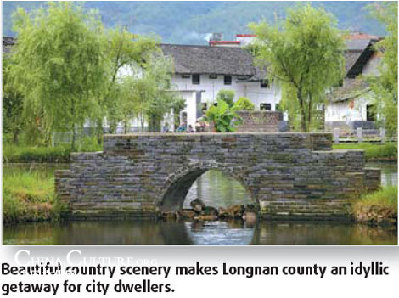
The Guanxi complex, south of Longnan, is one of the best-preserved Hakka residential structures in the country.
With a history of more than 200 years, the fortress-like rectangular farmhouse was built by a rich landlord. Construction lasted some 29 years. Covering a total area of 7,426 sq m, it comprises 18 halls and several dozen smaller rooms.
 |
|
|
The most impressive rooms are the ancestral halls. Surrounding these halls, and also located in the center of the complex, were rooms for the landlord and his family. Smaller rooms built in the outer walls were used by servants.
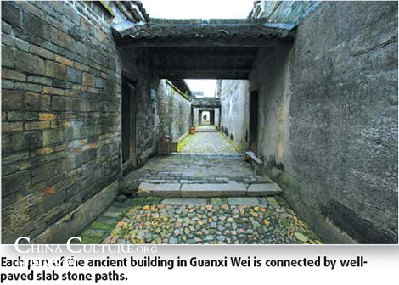
Well-paved slab stone paths within the complex are wide and straight. Exquisite wood, stone and brick carvings can be seen everywhere inside the labyrinth of buildings.
In 2001, Guanxi Wei was put under the State's protection. Inside the fortress, one can easily find a quiet corner to read.
Yanyi Wei
The complex of Yanyi Wei, in the Yangcun village, is the tallest fortified farmhouse in southern Jiangxi. The rectangular house, built in 1650, is four stories high, with nearly 15-m-tall and 1.5-m-thick walls. There are 34 rooms on each story of the building, all connected by the wooden corridor and against the outer walls.
 |
|
|
The only entrance to the complex has three gates. Different from the other weiwu in Longnan, the center of the complex is an open courtyard.
The whole structure projects both a sense of internal community, and a sense of defensiveness to the outside world.
Wushi Wei
Built about 390 years ago, the complex in Yangcun village is one of the earliest fortified farmhouses in the region. Among the region's fine examples of fortified farmhouses, it is the closest to the round type.
Constructed as a relatively wide half circle of two-story room-houses, it has a cluster of ancestral halls in the center. In front of the entrance is a pond, also in semi-circular shape. This architectural style is similar to that of buildings in the Meizhou area of Guangdong.
The complex, named after a big black stone (wushi) in front of the house, is famous for being the home of more than 19 successful candidates in the highest imperial examinations held in the palace during the Ming and Qing (1368-1911) dynasties.
Yuzaitan Wei
About 10 km from the county town of Longnan, Yuzaitan Wei in Xinli village features good examples of feng shui principles, as well as demonstrations of the making of fine traditional Hakka rice liquor.
Facing the Lianjiang River and the Yuzaitan Pond, the complex, with a history of more than 200 years, leans against two hills. A bridge, named Feng Shui, spans the Lianjiang River, and right above the Yuzaitan Pond it leads visitors to the entrance of the rectangular house.
With a length of 55 m and a width of 45 m, it has four watchtowers. While three of these are 12 m tall, the one standing at the southwestern corner is 15 m tall, because the farmhouse's southwestern corner is near a stretch of once-treacherous woods.
The owner of the farmhouse was a locally famous rice liquor maker. Different kinds of Hakka rice liquor, made of glutinous rice and water from the pond in the farmhouse, have long been popular in the region. At the complex, visitors can watch the whole process of Hakka rice liquor making.
Very light, with a sweet aftertaste, the celebrated beverage is more like a fresh soft drink than a liquor.
Liyuan Wei
Covering an area of 45,300 sq m - equal to the size of four football stadiums - and originally built between 1501 and 1536, Liyuan Wei is the largest and oldest fortified farmhouse in the region.
The complex comprises a farming section and a living section. The farming section has three fish ponds surrounded by paddy fields. The living section, with more than 400 rooms connected by 64 paths, is a real maze. The Liyuan Wei has four entrances situated at the east, south, west and north sides. The complex is ringed by a 789-m-long outer wall, and guarded by 12 watchtowers.
The ancient complex is still inhabited today. Travelers can see elderly residents chatting under arches, and children playing along paved paths.
If you want to enjoy this timeless tranquility before tourist crowds inevitably arrive at Longnan, there's no better time to go than the present.