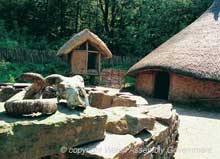
 The story of Wales begins with a group of tribes collectively referred to as the Celts.
The Celts began migrating from their central European homeland around 1000 BC.
Within 300 years the Celts' territory encompassed much of Europe, extending as far as Anatolia (modern day Turkey) in the east. As the Celtic peoples dispersed throughout Europe, their settlements became increasingly isolated from one another.
Meanwhile, the Roman civilization was on the rise in the Mediterranean, driving the Celts further west into the British Isles. The shift westward began around 700 BC and continued into the first two centuries AD, when Roman expansion was at its height.
After the Romans left Britain in the 5th century AD, marauding Germanic tribes further isolated the Celts in the north and west of Britain, in the Breton areas of France, and in Celtiberian Spain. These waves of invasion split the Celts into distinct communities.
The Pan-Celtic movement
The Pan-Celtic movement is an attempt to recognise the special nature of the Celtic heritage.
Involving the Welsh, Irish, Scottish, Manx, Cornish, Breton, Asturian and Galician peoples, it aims to maintain, promote and celebrate the rich Celtic heritage.
Movements over the years have supported the attempts of Celtic people to gain wider recognition for their unique identity or worked to create a Celtic network for the development of cultural links.
Language is central to the Pan-Celtic movement. All Celts were once unified by a common Celtic language, Old Celtic, from which all modern Celtic languages descend and the mission to maintain Celtic culture has often been linked to the preservation of individual Celtic languages.
The spread of Celticism
Since the industrial revolution, Celtic people have spread all over the world to escape conflict, poverty and oppression, or to search for work, adventure and new opportunities in other lands.
The Welsh set out to create a new Welsh community in Patagonia; the Scots went to Nova Scotia; the Irish to America.
Wherever they went they took their cultures and languages with them and groups grew in their new homeland to represent their interests.
Pan-Celtic movements not only support the interests of the Celtic homelands - Wales, Scotland, Ireland, the Isle of Man, Cornwall, Brittany, Asturias and Galicia - but also those of its people in other lands.
A range of Pan-Celtic festivals and cultural events such as film festivals, music festivals, art exhibitions and book fairs reflect and maintain the profile of Celtic culture worldwide.
The academic study of all things Celtic has boomed, with Celtic studies departments being set up in many universities across Europe and America.
點擊查看本頻道更多精彩內(nèi)容




