Sichuan: From an earthquake memorial to 'agritainment'
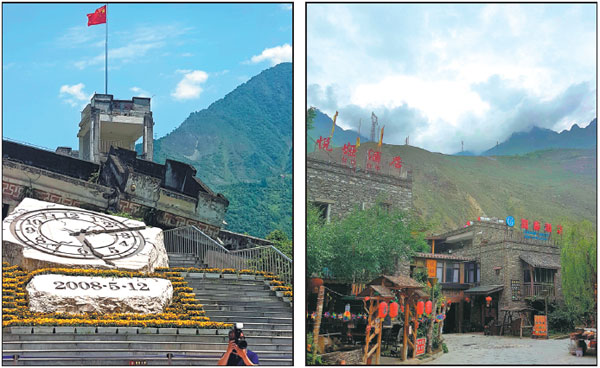
Collapsed buildings and rubble frame a sculpture of a huge jagged clock face inscribed with the date and time when a natural disaster struck Sichuan province on May 12, 2008.
The structures form part of the Wenchuan Earthquake Memorial Museum, located in the ancient town of Anren in Dayi county.
The edifice speaks to the triumph of the human spirit - the courage to get back up when all seems lost.
Nine years ago a devastating earthquake hit Wenchuan. More than 70,000 people were killed and nearly 5 million were left homeless.
|
Left: The structure of a clock at the Wenchuan Earthquake Memorial Museum is inscribed with the date and time when Sichuan was hit by a massive earthquake. Right: Taoping Qiang village, home of the Qiang people, is known for its ancient stone architecture. Photos by Melanie Peters / For China Daily |
Today breathtaking mountains and forests form the backdrop to the museum built in memory of the disaster.
The space, sombre yet tranquil, receives many visitors and tourists.
It is the epicenter of one of China's worst earthquakes in 30 years. With a magnitude of 7.9 on the Richter scale, the earthquake destroyed everything in its path.
A few years ago the Chinese government commissioned architects from Tongji University, in Shanghai, to build a museum as a reminder that man has little power when up against the force of nature.
The team was led by architect Cai Yongjie, and experts in the field of seismology were able to offer incredible sight. Cai designed large subterranean buildings with green rooftops. From above, it offers an image of a land cracked and destroyed by the underground tectonic plates.
In the museum stark photographs, relics and wax sculptures tell the story of the disaster and the rescue mission. An earthquake simulator forms part of the narrative to help visitors experience the vibrations of a real seismic event.
The museum is open daily.
Taoping Qiang village
About 16 kilometers from Wenchaun is Taoping Qiang village, in Guangrou county. It is home to members of the Qiang ethnic group. The village which dates back 2,000 years is well known for its ancient stone architecture. This includes a "mysterious oriental castle" which has piqued the curiosity of archaeologists. Tours are offered through a labyrinth of alleyways to discover more of the Qiang-style architecture.
It is a complex network of stone towers and dwellings constructed of earth, stones, hemp and wood. Each house has a white stone, a religious symbol, to ward off evil. The ancient watchtowers, ranging up to 30 meters high, take on shapes of hexagons or octagons. These solidly built towers and homes withstood the earthquake.
The Qiang people have also managed to preserve their culture and customs through the ages. In the village, women sell baskets of sweet cherries picked from nearby orchards and old men sitting at their gates enjoy barley wine. There are stalls with elegantly embroidered clothes, scarves and other trinkets particular to the region. Qiang-style embroidery is a Chinese cultural treasure and the forte of the local women. The skill has been handed down for more than 1,000 years.
Qiudi village, Lixian county
More than 2,000 meters above sea level in Sichuan's mountainous rural Lixian county, about 35 km from Wenchuan, is a small community of Jiarong Tibetans. They live in Qiudi village. Their lives, once marred by poverty, have been turned around through government programmes. Their economy received a welcome boost through yak farming, running a hydro project and tourism. Families have opened their homes to tourists who wish to experience their culture. It is a bed-and-breakfast of sorts which locals called "agritainment".
Hosts dressed in ethnic gowns welcome guests into their Tibetan-styled homes, which are ornately decorated with splashes of bold color. The mountain air is fresh and the local hospitality warm. It's a welcome retreat from city life.
The author is an online editor of South African newspaper Weekend Argus.