Companies scramble to take lead in developing 5G system
Chinese telecom companies are accelerating their research and development of 5G, as they scramble to establish a beachhead in the next-generation mobile communication technology.
China Mobile Communications Corp, the world's largest telecom carrier by subscribers, said it aims to deploy more than 10,000 5G base stations by 2020, in a move to launch a commercial 5G service.
With less than 1 millisecond needed for data to get from one point to another, 5G is expected to allow consumers to download an 8-gigabyte movie in seconds, and make remote surgery and autonomous driving a reality.
|
Engineers from Datang Telecom Technology & Industry Group test 5G terminal technologies in Beijing. Xinhua |
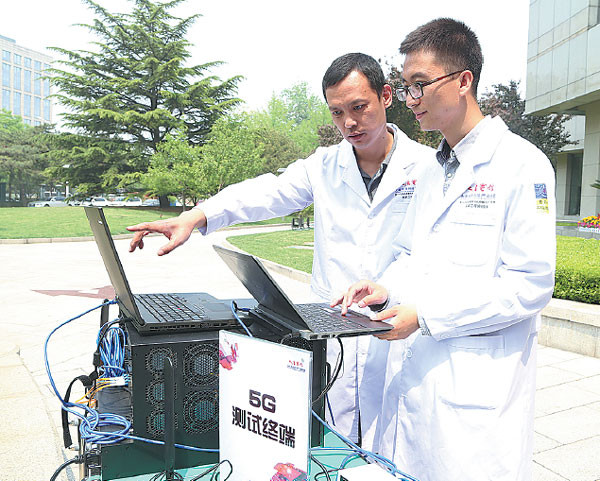
The Beijing-based company is building facilities for system verification and the development of pre-commercial 5G prototypes.
The moves are part of a broad effort by the nation to evolve from being a follower in the 3G era to an active participant that seeks to outdo foreign companies in the 5G era.
The mobile technology is so important that it was highlighted in this year's Government Work Report. According to a report by US company Qualcomm, 5G will help the global telecom industry create $3.5 trillion (3.1 trillion euros; £2.7 trillion) of output and generate 22 million jobs by 2035.
To accelerate the development of 5G technology, the Ministry of Industry and Information Technology said in a draft proposal on June 6 that the low-frequency bands - the 3,300 to 3,600 MHz spectrum and the 4,800 to 5,000 MHz spectrum - will be used for 5G networks in China.
"A frequency band is as important to telecom carriers as land is in the real estate industry," says Xiang Ligang, a telecom expert and CEO of telecom industry website cctime.com.
"Specifying the designated frequency band for 5G tests will motivate enterprises to channel resources to that band, thus promoting faster development.
According to Xiang, a low-frequency band can cover a larger area, which can lower the initial investment in 5G network construction.
"But the proposal does not mean that no other bands will be used for 5G. High-frequency bands will be used later to boost the internet speed," Xiang says.
China Unicom, the country's second-largest telecom carrier, is also scrambling to make a breakthrough in the technology. It recently set up the country's first pre-5G base station in Jilin province by partnering with telecom equipment maker Huawei Technologies Co.
The base station delivers a peak internet speed of 945 megabits per second-six times faster than the 4G network.
Earlier this year, China established the world's largest 5G test field to gain an edge in the race to standardize the mobile communication technology.
According to the Ministry of Industry and Information Technology, about 30 telecom base stations were built in that test field, in which China Mobile, Huawei and ZTE Corp are conducting China's second phase of 5G R&D.
The second phase focuses on testing technology solutions for the 5G mobile internet and the internet of things.
"5G will no longer be a simple technology or system," says Huang Yuhong, deputy head of the China Mobile Research Institute. "Instead, it is a platform in which the telecom industry needs to be deeply linked with other sectors. That is a fundamental difference between 5G and 4G."
In November, China Mobile outgunned foreign rivals to lead the global 5G System Architecture project, which will determine the structure of 5G networks. It came shortly after polar coding, a technology backed by Huawei, was approved as part of the global standard for 5G.
"The progress highlights Chinese companies' rising influence in the global telecommunication arena," says Fu Liang, an independent telecom analyst. "It is a recognition of both their technological prowess and their brand influence."
masi@chinadaily.com.cn