Promoting innovation in space science
China has always known that only through innovation in space science and technology can it become a space power. In the past year, scientists and engineers have made major breakthroughs in the technology needed for space exploration.
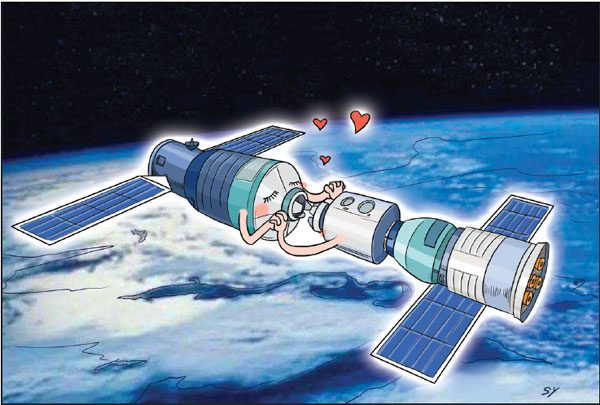
Tianzhou-1, China's first cargo spacecraft, was launched into space and docked with the orbiting Tiangong-2 space laboratory last week. A retrievable scientific research satellite, SJ-10, went into space in April 2016 and completed experiments in microgravity and space life science.
In June 2016, Long March-7 Y2, the medium-sized carrier rocket used to lift Tianzhou-1, made its maiden flight. Four months later, the Shenzhou-11 manned spacecraft was launched and docked with Tiangong-2 where the two astronauts lived for 33 days.
Aerospace innovation can directly benefit people, as more than 2,000 aerospace inventions are used in various sectors to promote social and economic development. For example, turbine-pump technology developed for the aerospace industry has been used in a fire pump to spray water as high as 400 meters.
China plans to launch six to eight BeiDou-3 satellites later this year as part of a plan for the 35 domestically made satellites to provide worldwide navigation services by 2020.
China designated the Space Day - the second one was observed on Monday - to encourage innovation and mark the anniversary of the launch of its first satellite, Dongfanghong-1, in 1970. More than four and a half decades later, China plans to launch the Chang'e-5 lunar probe at the end of November this year, and experts say the country could realize the dream of putting astronauts on the moon within 10 years.
China's contribution to the space industry has been widely appreciated. Making peaceful use of outer space, China has signed cooperation agreements with more than 30 countries and organizations, including Russia, Kazakhstan, Germany, France, the European Space Agency and the United Nations Office for Outer Space Affairs.
China has also helped more than 20 countries and regions with 50 launches, and exported satellites to nine countries. Besides, it will become the only country with a permanent space station when the International Space Station retires in 2024.
China will continue to promote innovation in space science, space technology and space applications, contributing more to both national development and the well-being of humankind.