Chinese have designs on fashion world
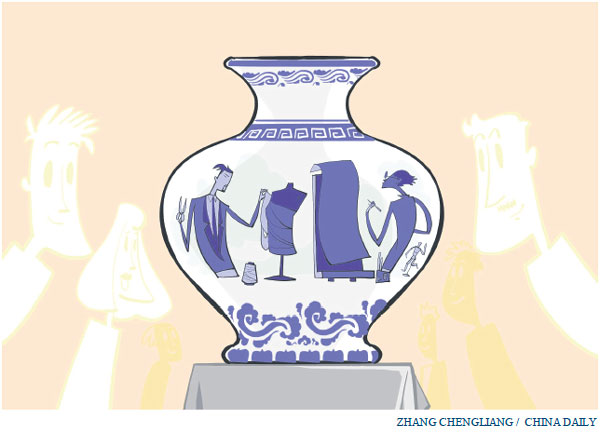
Europeans need to understand the demand for mainland influences and the products the customer wants
The meaning of the mantra "made in China" is fast changing. It was once associated with mass production, low quality and a lack of innovation and investment. Nowadays, creativity and innovation are fast replacing this increasingly anachronistic image, and nowhere is this happening more than in the clothing industry, where young Chinese designers increasingly showcase sophisticated and stylish collections.
An army of younger Chinese fashion designers are now not only gaining prominence in the domestic mainland market but also internationally. Consequently, Chinese consumers' heads are being turned away from the best-known Western fashion brands.
The European fashion industry will be hearing a lot more about these Chinese designers and needs to understand the implications for brand management in the future.
However, it is still the case that most European fashion brand managers and most European fashion consumers remain blissfully unaware of the growing number of innovative, talented Chinese designers.
The European fashion industry should also be aware that more of these precocious young designers are choosing not to base themselves in Europe, but instead to stay close to their roots, setting up camp in or near their hometowns in China.
Basing themselves firmly in China is probably a reflection of the local influences to be found in more and more of their work.
Who better to start with as an example than Qiu Hao? Born in the city of Taicang, Jiangsu province, not far north of Shanghai, Qiu rushed out his first ready-to-wear clothing line as far back as 2001 and soon after followed this up with the opening of his own boutique, OneByOne, in Shanghai. Immediately after graduating from the UK with an MA in fashion management, Qiu chose to return to his origins, setting up in Shanghai and launching his eponymous label. His work first met with international acclaim when his 2008 collection was displayed at the Palais de Tokyo as part of Couture Fashion Week 2008. Qiu's collection was awarded the internationally prestigious Woolmark Prize.
Qiu is typical of this new breed of audacious Chinese fashion designer, often using surprising fabrics.
Liu Min, often referred to as simply Ms Min, is another young Chinese designer who has eschewed the bright lights of Europe's fashion capitals and chosen very deliberately to base herself on the Chinese mainland. Ms Min works out of the beautiful southeastern coastal city of Xiamen, very much the jewel in the crown of Fujian province. Never one to follow the crowd, Ms Min is very public about the extent to which her Chinese heritage lies behind much of her work. Ms Min's designs are often characterized by the presence of Chinese motifs and techniques, but she also draws on more modern Western styles to create a fantastic fusion of approaches.
Ms Min's Spring 2016 collection perhaps most typifies her work, with cheongsam tailoring, kimono-style wraps and bold prints. Simplicity and romanticism lie at the heart of Liu's creations, and the term "functional luxury" has often been used to sum up her designs. Such has been her burst onto the international fashion scene that Ms Min was short-listed last year for the prestigious LVMH Prize for Young Fashion Designers.
It is no surprise that her designs have also met with success across China, appealing to an increasingly polished yet bold younger Chinese fashion consumer.
It is also of little surprise that young Chinese fashion designer Christine Lau is responsible for one of China's most popular home-grown fashion labels, Chictopia. Born and still based in Beijing, Lau launched Chictopia in 2009, with a combination of traditional Chinese influences and modern styles. Lau also studied in Europe before choosing to return home.
Not that all of these fast-rising Chinese fashion designers were educated in Europe. Ban Xiaoxue received his education at the Tianjin Academy of Fine Arts before working as principal designer for the Chinese womenswear brand Exception, from 2007 to 2012. Ban went on to launch his own label in 2012, the year that also saw him awarded the prestigious Woolmark Award in China. Since then, Ban's collections have received international acclaim and have been showcased at Shanghai Fashion Week. Ban's designs also aim to create a fusion between contemporary and traditional Chinese styles.
Masha Ma, splitting her time between Shanghai and Paris, is also indicative of the new breed of designer. Despite being educated in Europe, Ma chose to return to Shanghai soon after graduation and launched her eponymous label 2008. Born in Beijing, Ma draws on her Chinese heritage in her designs as well as incorporating a modern, futuristic flavor in her work. In 2013, Ma's collections were rated so highly that she was selected for the prestigious CDFA/Vogue Fashion Fund China Exchange Program and, as a result, was based in New York for several weeks, learning about the US fashion industry. Lady Gaga and Naomi Campbell are just two of the many international celebrities who admire her work.
Another example of a Chinese fashion designer with a preference for a base in China is Shanghai's Uma Wang. Success after success in Europe led to Wang's fans imploring her to return to China and open up a shop in Shanghai. Wang's Shanghai boutique, named Xintiandi, stocks her signature hand-knitted chunky dresses, cloaks and cardigans that possess a beautiful blend of fabrics, silhouettes and textures. Not that one needs to venture to Shanghai to find Wang's avant-garde, luxury knitwear pieces, which can also be found in fashion boutiques across Europe. Wang's creations are also showcased frequently on the runways of the leading fashion capitals in Europe.
Clearly, this army of young, innovative fashion designers is well and truly on the march, and the European fashion industry, from suppliers through to retailers, needs to become fully conversant with this trend. But, as is often the case, the "devil is in the detail", and the designs also warrant close attention.
Internationally successful younger Chinese fashion designers often choose Chinese influences as the dominant feature in their work and have also chosen to return to China soon after graduating from top European fashion schools.
These designers' roots explain this phenomenon, but only partially. It is also due to the lure of younger Chinese fashion consumers, who now almost demand some kind of Chinese influence and appearance in the clothes they buy. This lies behind this relatively new phenomenon.
It therefore behooves the European fashion industry, especially the best-known brands, to get back to the drawing board and incorporate consideration of Chinese influences in all aspects of their fashion brand management system.
It could only be a matter of time before Chinese influences catch on with European consumers and they too begin to beg designers to incorporate Chinese features into their work.
Italian style and a French flavor could soon be usurped by younger Chinese fashion designers.
The author is a visiting professor at the University of International Business and Economics in Beijing and a senior lecturer at Southampton University. The views do not necessarily reflect those of China Daily.