University's stress on fitness is welcome
The rules aren't very strict, but they could help students develop better habits and lead healthier lives
Tsinghua University recently announced that starting from this year its students will not get certificates of graduation unless they know how to swim. After Tsinghua's decision, some media outlets reported that Xi'an Jiaotong University in Northwest China's Shaanxi province has for nearly two decades required its undergraduate students to learn and practice tai chi.
Given that Chinese universities are not known for linking sports to their courses, the regulations of Tsinghua and Xi'an Jiaotong universities seem out of place. This becomes even more obvious when one considers the fact that the two are century-old, prestigious universities whose regulations and courses draw wide public attention.
But a closer look shows their decisions should not have sparked a controversy. Anyone acquainted with Tsinghua University's curricula knows that physical education, as with other professional courses, includes compulsory and selective sections which students have to pass to be eligible for graduation. In fact, such regulations are normal at any university or college in China.
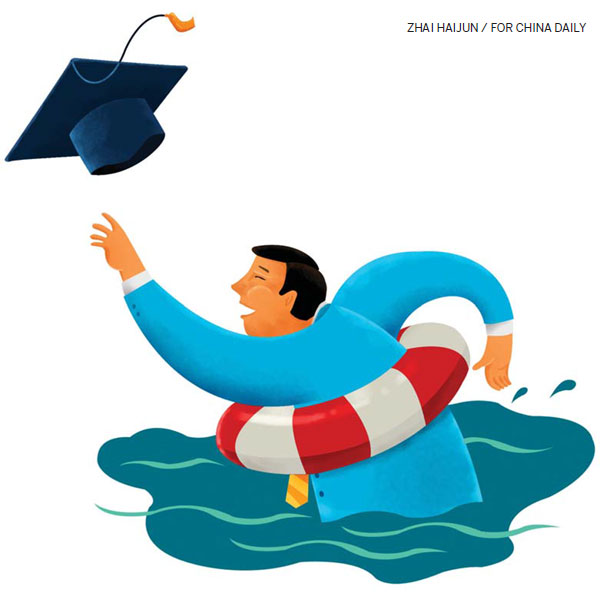
The university's regulation is reasonable for several reasons. First, the Tsinghua University campus has excellent swimming facilities where students have access to basic as well as high-quality swimming courses, and thus can practice or learn swimming.
Second, the university's regulation does not require every student to be an ace swimmer; it only requires the students to attain basic swimming skills. Given that many Chinese children now learn swimming at a very young age, it should not be difficult for them to fulfill the requirement.
Besides, students who don't know how to swim, especially those from China's dry northern regions, can learn under the guidance of coaches before or after attending their academic classes. And students who cannot learn to swim for various reasons can sign up for other sports or physical education courses.
Third, swimming is cardiovascular exercise that builds muscle strength and endurance. And since Tsinghua University has modern swimming facilities, it is justified in helping its students to practice and remain physically fit.
Xi'an Jiaotong University, as with Tsinghua, does not require every student to be a highly skilled tai chi practitioner. It only requires students to know some basic exercises and keep practicing them.
One reason the decisions of Tsinghua and Xi'an Jiaotong universities have caused a controversy is that physical education has long been marginalized in China. Even though it is compulsory at many universities, authorities usually don't attach much importance to it. That's why physical education teachers, more often than not, cannot set strict teaching requirements.
This marginalization of physical education has led to a decline in students' physical health and a reluctance to participate in sports. In this context, the regulations of Tsinghua and Xi'an Jiaotong universities will help students maintain physical fitness to a certain degree.
Universities should be open to social supervision, but they should also have the autonomy to manage their affairs, pass regulations and set their requirements free of outside interference.
The author is a professor with the College of Liberal Arts, Journalism and Communication, Ocean University of China. This article first appeared in Beijing News. The views on this page do not necessarily reflect those of China Daily.