Study results uncover major component of smog in China
Scientists said on Wednesday that they have solved the mystery of how a major smog component, known as sulfate, forms during heavy pollution.
The study, published in the US journal Science Advances, identified reactive nitrogen chemistry and water particles in the air as the two key elements, suggesting that reducing nitrogen oxide emissions, in particular, may help curb air pollution.
The findings were based on an analysis of heavy smog in Beijing in January 2013, one of the worst incidents of atmospheric pollution ever recorded in China, which saw the daily concentration levels of hazardous PM2.5 exceed the World Health Organization's guideline by 16 times.
They identified a reaction pathway that could account for the missing source of sulfate, discovering that fine water particles in the air acted as a reactor, trapping sulfur dioxide molecules and interacting with nitrogen dioxide to form sulfate.
The reaction rate was further facilitated by stagnant weather during that time, which trapped nitrogen dioxide near the Earth's surface, resulting in nitrogen dioxide concentrations that were three times higher than normal.
Researchers said the process was "self-amplifying", as increasing aerosol mass concentrations led to higher aerosol water content - accelerating the accumulation of sulfate and causing more severe pollution.
"In cleaner environments, sulfate is mainly formed through the traditional hydroxide reaction pathways in the atmospheric gas phase, or the hydrogen peroxide and ozone reaction pathways in cloud chemistry. However, in China, the dominant sulfate formation pathway shifts into the nitrogen dioxide reaction pathway in aerosol water," said study author Zheng Guangjie of Tsinghua University.
Zheng said the research reveals "the complex nature" of haze pollution in China.
"Pollutants from various sources were emitted at a high intensity at the same time, resulting in the unique heavy haze conditions, and thus shifting the dominant sulfate formation pathway. The complexity of haze pollution in China further illustrated the importance of scientific emission-reduction strategies."
These results "will need to be considered in future air quality and pollutant emission control strategies in North China, and perhaps also in other regions", the researchers concluded in their paper.
|
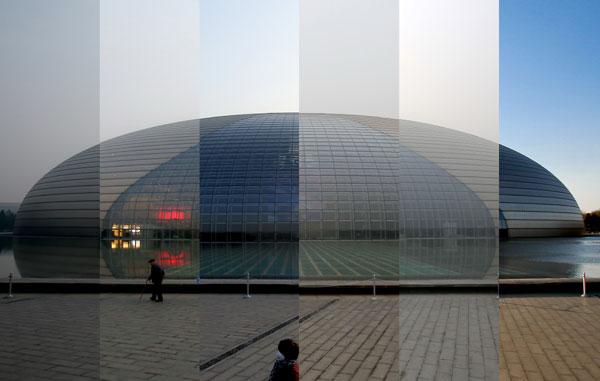 A collage of six photos in chronological order from left to right, dating from Dec 17 to Thursday, shows the difference in air quality on each of the days at the National Center for the Performing Arts in Beijing.Zhang Cheng / Xinhua |