Shaking off a health nightmare
A disease known as ET can occur at any age, but is most common among people in their 40s and those older than 60. It impairs daily functions such as eating and drinking. But it can be treated successfully.
When someone mentions ET, most people will probably think of the science fiction movie E.T. the Extra-Terrestrial. Few know that ET also stands for essential tremor, a painful chronic disease.
As its name suggests, the disease is disorder of the nervous system that causes uncontrollable and rhythmic shaking. It can affect any part of the body, especially the upper limbs. Sometimes it affects the head and the voice.
|
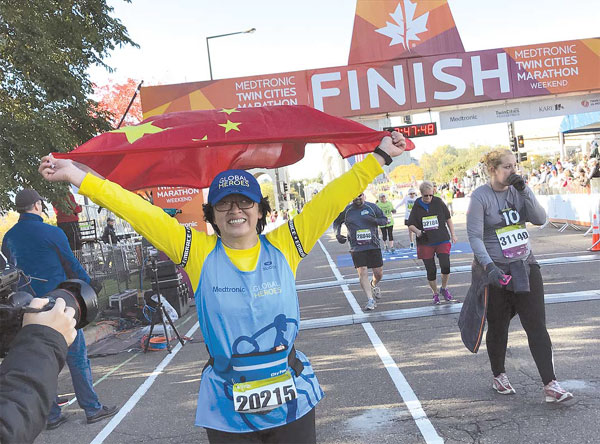
Chinese patient Chu Shuqin finishes a full marathon in 2 hours 33 minutes during the Medtronic Twin Cities Marathon held last month in Minnesota. Photos Provided to China Daily |
It can occur at any age, but is most common among people in their 40s and those over 60. It impairs daily functions and, as it worsens, even drinking from a cup without a straw becomes difficult.
Among the general population the incidence of ET is between 0.3 and 1.7 percent. Among people older than 45 and people older than 65, the rates are 5.5 and 10.2 percent, respectively, says Li Jianyu, a senior specialist in neurology and movement disorders at Xuanwu Hospital in Beijing.
Many patients, especially older people, do not seek treatment when they first notice the tremors because they think it is normal for older people.
"Essential tremor may be novel for many, but it is not that uncommon," says Li. "It is a pity that many people, including medical personnel, are not aware of the condition."
Chu Shuqin, a 49-year-old woman from Hebei province, knows the cost of ignorance about the disease.
On Oct 9, Chu became a "global hero" when she participated in the 2016 Medtronic Global Heroes Program, and completed a full marathon - about 16 kilometers - in 2 hours and 33 minutes.
The global program, which has been in operation since 2006, annually selects 25 long-distance runners who suffer from the disease - but who are benefiting from medical technology - to represent their countries in the marathon event in Minnesota, in the US.
"Through running the marathon I hope to make more people aware about essential tremor, and I hope to prove that you can enjoy a normal life with proper treatment," Chu says.
Her story goes back almost 10 years, when her hands started shaking a little. She attributed it to overwork and fatigue and didn't pay much attention.
But the shaking occurred more often. Once, during a dinner, she found herself unable to pour baijiu into people's cups. She could not write properly or cut her nails, so she finally decided to seek medical help.
Her doctor diagnosed her with Parkinson's disease and prescribed medication that had no effect.
As her condition worsened, she went to another hospital, where a doctor suspected she had essential tremor and suggested she visit Beijing Xuanwu Hospital.
There, at what is one of China's top facilities for neuroscience and gerontology, Chu was finally diagnosed correctly.
Despite the delay in diagnosis, Chu is lucky when compared with most patients, who typically go through between 10 and 15 incorrect assessments before finally being diagnosed with essential tremor, experts say.
That is because doctors in smaller towns are not aware of the disease, and also because it is very tough to distinguish between essential tremor and Parkinson's disease, especially in the early stages, Li says.
Neither blood tests nor medical imaging can help diagnose it. The diagnosis is typically based on the doctor's observation of the patient and the way they respond to medication, says Li.
For instance, Li says, Parkinson's patients tremble all the time and often the tremors are accompanied by other symptoms, such as stiffness and sluggishness in movement. On the other hand, those suffering from essential tremor, especially in the early stages, shake only when in motion. Sometimes patients can have both the diseases at the same time.
As for treatment, ET is not curable, but it can be controlled and managed. The problem is that many patients do not understand the condition and are reluctant to accept medical intervention.
Medication can alleviate the symptoms for some patients. But for those who cannot perform daily activities because of the tremors there are surgery options. One of these is thalamotomy, the precise destruction of the thalamus, a tiny brain structure that controls some involuntary movements.
Another option is deep brain stimulation, or DBS, in which doctors insert a probe to transmit painless electronic pulses to the thalamus to interrupt signals from the brain.
The electronic pulses are generated through a pacemaker implanted in chest and are transmitted through a wire that connects the pacemaker and the probe.
Thalamotomy is not reversible and, if conducted on both sides of the brain, may cause speech and cognitive problems.
DBS is a better choice for younger patients who need to work, or for patients who have tremors in the head and the voice, says Li.
However, many patients reject the idea of having medical devices implanted in their brain, says Li.
Chu recalls that she refused to undergo the surgery at first simply because she knew too little about the disease and feared the device would make her look like a robot. Cost was also a factor.
Then, suffering from depression caused by her condition, Chu summoned the courage to undergo the DBS surgery in 2009. It was successful.
After the surgery she resumed running, something she had enjoyed since she was young but had to give up due to the disease.
She did not hesitate to apply for the marathon program when she saw it on Medtronic's public WeChat account.
Not long ago, she was removed from an essential tremor WeChat group, because she tried to introduce the DBS treatment to other patients.
"Ordinary people know very little about essential tremor and there is misleading information out there," Chu says.
"I hope sufferers make fewer mistakes and have better access to authoritative, regulated and effective treatment."
liuzhihua@chinadaily.com.cn