Restaurant chain shows its sushi roots
Having won the opening auction for bluefin tuna at Tsukiji's first fish market of the year for four years in a row, Itamae Sushi is now looking for glory from long ago.
The company has opened around 60 restaurants in Japan, the Chinese mainland and Hong Kong, Singapore and Indonesia - operating Itacho Sushi outlets in Beijing, Shanghai, Guangzhou, Shenzhen, Tianjin, and Guangdong province's Foshan and Zhuhai.
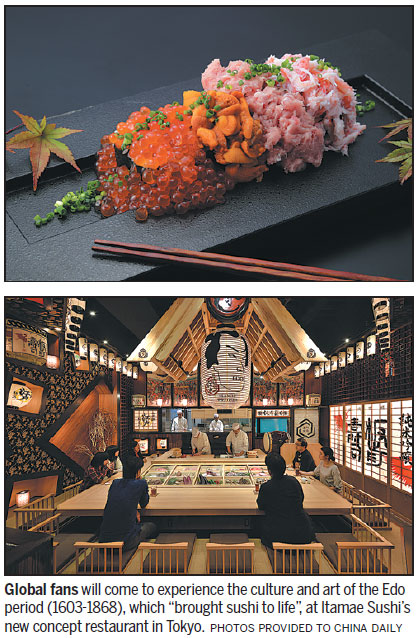
Now it's hoping that global fans will come to experience the culture and art of the Edo period (1603-1868), which "brought sushi to life", at its brand-new concept restaurant in Tokyo.
"During this period, sushi was born from food stands," says the company's Claudia Sun. "Food is one of the things that supported the evolution of Edo. Food items came together at Tsukiji, and thus present-day Tokyo was formed, and became a city where many people gathered."
The Itamae Sushi Edo restaurant, which is modeled after the sajiki-seki box seating in a kabuki theater, features an interior design that conveys the feeling of Japanese tradition through elements such as Japanese panel screens and ukiyo-e paintings. "Edo Food Stand" areas feature ingredients carefully selected from all around the country, and guests can enjoy watching a live performance where Itamae chefs prepare meals on the spot, using the food and cooking style of each guest's choice.
In the Edo period, sushi was lined up in wooden boxes called neta-bako. Inspired by this tradition, the food stands line up neta-bako in neat rows, almost as if they were part of a picture, featuring foods carefully selected from all over Japan. This collection of neta-bako makes for an atmosphere like a "Little Tsukiji" where seasonal foods from all over Japan come together. Guests can choose the food of their preference and also order from a wide range of preparation styles, including sushi, sashimi, sauteed, steamed and boiled.
Sun says the restaurant is unique and created not only to appeal to Japanese customers, but also foreign guests visiting Japan, who are projected to exceed 40 million in 2020 and 50 million in 2025, according to the Japanese National Tourism Organization. The photogenic interior design, experience-oriented dining and a colorful menu are designed to inspire guests to take pictures and share them via SNS, in an effort to spread Japanese culture - and particularly sushi culture - around the world.
The restaurant opens on Thursday, combining Japan's famously fresh seafood with the traditional techniques the country's sushi masters have inherited from the past. It also offers a wide selection of Japanese sake carefully selected from all around the country.