The building of a nuclear family
Hinkley Point investor CGN wants to share its valuable experience with the world and provide clean energy, chairman says
A lot has been written and said about China General Nuclear Power Group this year, especially last month when it signed a final agreement to invest in Hinkley Point C nuclear plant.
The company will contribute one-third of the 18 billion pounds ($2.69 billion; 2.4 billion euros) needed to build the power station, which is scheduled to go into operation in 2025.
|
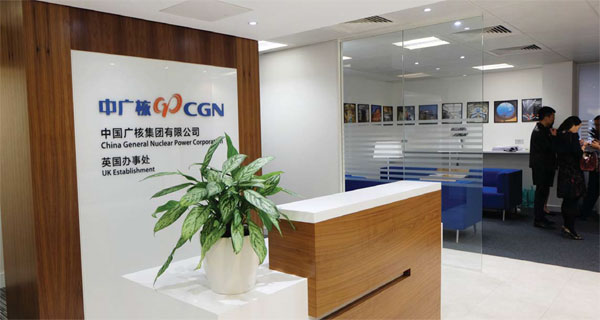
China General Nuclear Power Group's London office. Cecily Liu / China Daily |
Once finished, the plant is expected to create 25,000 jobs and meet 7 percent of Britain's energy demand, with supplies continuing for six decades.
The contract inked last month came after four years of discussions and visits by British government officials to CGN-operated nuclear plants in China as well as an unforeseen delay in July when Prime Minister Theresa May called for a full review of the project.
CGN's involvement in Hinkley Point is significant as it is the largest Chinese investment so far in Europe, but also it sets the ball rolling on China's plan to see its third-generation nuclear reactor, the Hualong One, used in a proposed power station at Bradwell, on the southeast coast of England.
If the reactor passes Britain's rigorous general design assessment for nuclear technology, a strict process that can take five years, Bradwell could well become the first nuclear plant in a developed country with a Chinese reactor, paving the way for further exports of the technology.
So it is perhaps easy to see why Liu Xiaoming, the Chinese ambassador in London, would refer to the Hinkley Point contract as the "golden fruit" of China-UK collaboration.
Yet despite the excitement surrounding his company, CGN Chairman He Yu is a picture of calm and quiet confidence when he sits down to an interview in CGN's new offices beside London's Green Park.
"It's true the British public may have concerns about our nuclear technology, but we plan to do a lot more to build their trust," he says. "We believe transparency is the most important element in the communications process."
His words come after speculation in the British media that May's delay in approving Hinkley Point stemmed from concern over Chinese investment in such a large infrastructure project, a sentiment that appears to be backed up by measures added to the final agreement.
Crucially, the British government has established a new regulatory framework that states it will hold a "golden share" in crucial infrastructure projects involving foreign investors. Limitations were also imposed on Hinkley Point's majority investor, French energy company EDF, that block it from selling its shares before construction is complete.
Some industry analysts say the conditions point to a tightening of the environment for foreign investors in infrastructure and point to May's chief of staff, Nick Timothy, who was quoted in the media as saying that China could "build weaknesses" into the Hinkley plant's computer systems that would "allow them to shut down Britain's energy production at will".
However, He Yu says CGN is not worried. The extra conditions will have no impact on its nuclear investment decisions, he says, adding that the British government's desire to be involved in crucial infrastructure projects is understandable and common practice globally.
CGN, formerly China Guangdong Nuclear Power Holding, was established in 1994 as a key state-owned nuclear company. It was listed on the Hong Kong Stock Exchange in 2014.
By the end of last year, the company managed 14 nuclear plants, with a combined installed capacity of 14.92 gigawatts. That's 56.5 percent of the total nuclear power installed capacity in China. The company also has another 14 plants under construction.
CGN's first nuclear project was the Daya Bay plant in Shenzhen, which was built in partnership with Framatone, a French company later renamed Areva and acquired by EDF. Daya Bay's two reactors started commercial operation in 1993 and 1994 respectively.
From there, He says his company developed a close partnership with EDF based on trust and an understanding of each other's technologies.
Chain reaction
CGN went on to construct the second phase of the Fangchenggang nuclear power station in South China's Guangxi Zhuang autonomous region. The plant uses the Hualong One, which was jointly developed by CGN and China National Nuclear Corp.
The reactor's core technology, ACP1000, passed the International Atomic Energy Agency's generic reactor safety review in December 2014, signifying that the technology is safe for international export.
He Yu says CGN is in talks to export the reactor to Thailand, Indonesia, Kenya, South Africa, Turkey, Kazakhstan and the Czech Republic, while negotiations with Romania are at an advanced stage, with an announcement on a joint venture expected this year.
It is now hoped Hualong One will become only the second or third reactor to pass Britain's general design assessment, joining the European Pressurized Reactor, which will be used at Hickley Point. Westinghouse's AP1000, a technology from the United States, is still awaiting approval.
"Once Hualong One passes the British assessment, it will boost more countries' confidence and push forward the reactor's global market development," He says.
CGN established a project department in February 2015 to work on the regulatory process for the assessment. Technical preparations were finished in July.
If the Chinese reactor is used at Bradwell, He says CGN will be the majority stakeholder in the project, holding a 66.5 percent share. "It means we'll bear responsibility, and our returns will be higher," he adds.
He emphasizes that CGN aims to "use British talent to build a British power plant" by boosting its UK branch with local recruits and incorporating British nuclear industry supply chain companies into its Hualong One technology during the localization process.
As Britain does not have its own third-generation nuclear technology, these firms are keen to cooperate with CGN, with a view to securing more deals when the Chinese company starts to build reactors in other developed countries. Companies likely to be interested include Rolls-Royce, Centronic and Delta Controls.
He Yu, who graduated from North China Electric Power University, joined CGN in 1986. He was part of the first wave of "golden talent" in the nuclear industry who were sent to France for further training.
On his return, he trained younger nuclear professionals, and he says proudly that skilled and innovative people are one of the reasons why China's nuclear industry is so competitive.
"If I belong to the golden generation, then our young executives must represent the diamond generation," he says.
He recalls when he supervised the Daya Bay project and allocated two French trainers to assess students: "I gave them the job because they didn't know any of the students, so they could dismiss those who weren't good enough in a fair and objective way. That is a demonstration of how strict we are on talent education."
In addition, CGN has kept up a tradition over the years of sending executives abroad for graduate degree training. The move familiarizes them with global practices and norms, and paves the way for the internationalization of China's nuclear technology, He says.
"Our objective is to provide clean energy, and because China has more than three decades of experience in the nuclear industry, we want to take these valuable experiences global."
cecily.liu@chinadaily.com.cn