


'Sky rivers' may divert weather
Who says you can't do anything about the weather?
Initial research has begun on a way to modify weather patterns to divert massive amounts of water vapor from a place where it's wet to another that's dry.
Scientists are planning to accomplish the goal using weather modification techniques, according to the Xinhua News Agency.
|
Scientists may soon be able to move clouds. Huang Xiaobing / For China Daily |
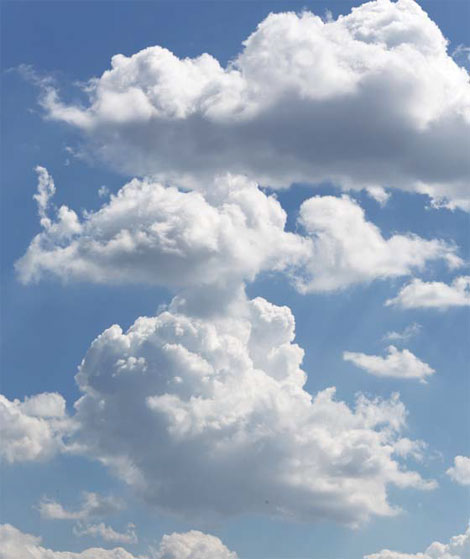
The Tianhe Project (the name means "sky river") aims to guide air that's saturated with water vapor above the Yangtze River basin northward to the Yellow River basin, where it would become rainfall, says Wang Guangqian, president of Qinghai University and an academician at the Chinese Academy of Sciences.
In theory, the project could eventually divert 5 billion cubic meters of water annually across regions - an amount equivalent to 350 Hangzhou West Lakes - to alleviate water shortages in the Yellow River basin and other inland rivers, Wang says.
Wang has been leading a research team of many top scientists looking into the underlying principles for years, including Wei Jiahua, deputy head of Water Resources and Electrical Engineering at Qinghai University.
"By the end of June 2017, we expect to have made some progress toward a certain level of capacity to conduct tests," says Wei, a water resources researcher at Tsinghua University.
Wei says the team has conducted some initial experiments using satellites and ground stations to monitor results, and it will continue to deepen its work with more institutes.
Current research has found stable and orderly passageways that can transport water vapor at the boundary of the troposphere. These passages could be called tianhe, or sky rivers.
Following basic physical laws to transform liquid water on the land to vapor in the air, and then learning how to transport it accurately, the scientists believe they can use rockets to trigger rainfall.
The concept of the sky corridor will maximize the ecological effects of the Qinghai-Tibet Plateau, boosting the economic and social development for the whole country, especially in the northern areas, says Bao Weimin, an academician at the Chinese Academy of Sciences.
"The project has wide and promising prospects for applications," Bao says.
It's not the first time that scholars have considered the feasibility of delivering atmospheric water resources to drought-stricken regions. Discussions have been underway at various levels for decades.
Around 2000, a plan emerged to shift precipitation from the Yarlung Zangbo River area to China's dry northern region.
But scholars never got on board with the concept because of the problem of complex and variable weather conditions, along with geological influences.
In 2007, Gao Dengyi, a researcher at the Institute of Atmosphere Physics, which is part of the science academy, concluded the idea wasn't feasible.
zhengjinran@chinadaily.com.cn
















