Panchen Lama's teaching praised at Tibet ritual
|
The 11th Panchen Lama, surrounded by monks, gives blessings to Buddhist pilgrims on Sunday during a four-day sacred event in Tibet's Xigaze city. Galsang Jigme/ Tibet Daily |
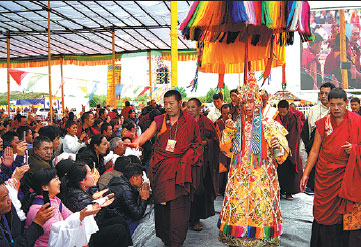
High-ranking Tibetan monks and Living Buddhas have praised the recent Kalachakra teaching delivered by the 11th Panchen Lama in southwestern Xigaze city.
The four-day sacred event, which concluded on Sunday, drew thousands of Buddhist pilgrims, monks and nuns from many Chinese provinces.
More than 110,000 attended the teaching on Saturday, according to the Tibet autonomous region's government information office.
The Kalachakra is a ritual that aims to initiate and empower disciples, according to Tibetan Buddhist tradition. Kalachakra means "wheel of time".
"We consider Panchen Rinpoche as the reincarnation of the Amitabha (a celestial Buddha), and I feel honored and pleased to hear the teachings," said Lobsang Konchok, a lama from Zablung Monastery of Qinghai province's Huzhu county. Rinpoche means "treasure" and is another way to refer to the Panchen Lama and other masters.
The 49-year-old said he previously received one teaching from the Panchen Lama, in the Yonghe Temple, the largest Tibetan Buddhist temple in Beijing.
"It is his first time to deliver a Kalachakra teaching, but he is so experienced and skilled with the procedures. This is incredible," Lobsang Konchok said.
Lobsang Gyaltsan, a monk, and the deputy director of the Champaling Monastery Administrative Committee in Tibet's Qamdo city, said: "I am pleased to listen and learn the Kalachakra teaching with thousands of religious devotees from many provinces."
He also said he appreciated the central government, the State Council, and the regional government for the considerable preparation and the great opportunity they have provided for many devotees.
Lobsang Gyaltsan said the Panchen Lama is still young, but already he has a profound knowledge of Buddhist philosophy, and the procedures of the Kalachakra teaching were carried out in the correct traditional order. The Panchen Lama is 26.
"As a patriarchal high-ranking monk, we have to learn from the former great masters such as the Sakya Drogon Phakpa, the 10th Panchen Lama, and Phakpala Gelek Namgyal," he said.
"Panchen Rinpoche is one of the highest spiritual masters in Tibetan history, and the Panchen Lama is a good model for the young Living Buddhas and lamas to learn from," said Thubten Drakpa from Gyatsoling Monastery in Tibet's Palpar county.
"I think the grand Kalachakra teaching event will also help to bring harmony between the different schools of Tibetan Buddhism."
Leshe Thogme, the head of the Shannan Buddhism Federation, said attending such a teaching is useful for both this life and the next life.
"It is an auspicious thing to attend such event," he said.
Daqiong contributed to this story.
Contact the writers at palden@chinadaily.com.cn
Living Buddha who returned home
A Living Buddha who stayed overseas for more than half a century, Koondhor Jewon Tulku, has taken a long path to take part in the sacred Buddhist ritual hosted by the 11th Panchen Lama between Thursday and Sunday.
Jewon, who left Tibet in 1959 and returned in 2011, was among the 5,000 monks and nuns attending the first Kalachakra instruction delivered by Panchen Lama Bainqen Erdini Qoigyijabu.
The ritual attracted over 110,000 devotees on Saturday to listen to the Kalachakra instructions in a venue near Tashi Lhunpo Monastery, the Panchen Lama's traditional seat, in Xigaze of Tibet autonomous region.
Jewon, who was reincarnated as a Living Buddha in the Qamdo prefecture of Tibet in the 1950s, according to Buddhist belief, he is impressed by the Buddhist attainments of the Panchen Lama at the young age of 26.
"I hope he will go on to become a knowledgeable and great religious leader," he said.
Jewon left Tibet for India in 1959, before settling down in Switzerland in the 1970s.
Jewon said it was the local authorities' persistent investment in Buddhist temples, and policies that respect religious freedom, that made him decide to come back in 2011.
"I saw temples are being refurbished, and connected with roads, electricity and tap water. The authorities have also included the monks and nuns in social insurance programs. That was simply unimaginable in the old times," he said.