Cafe coffers are full, but coffee has no moxie
Last week, yet another cafe opened near my Beijing office, deep in the bowels of a hotel. I made my way in nevertheless, lured by its glossy flyers.
Stirring of any sense - aroma, sight, touch, imagination - of caffeine connoisseurs could raise hopes for a stimulating coffee and trigger the impulse to go and have one.
This aspect of the subconscious mind Chinese food-and-beverage entrepreneurs seem to understand, going by the ubiquitous cafes and coffee-serving establishments in Beijing and Shanghai. In doing so, they may have discovered a potential winner, never mind the spotlight on wines and liquor.
Coffee addiction can make you do strange things - like parting with up to 40 yuan (around $6) for a cup, having back-to-back shots of different flavors, and generally filling the coffers of coffee shops.
Coffee-dedicated startups like cafe chains and quick service restaurants or QSRs are a global trend. In India, mysterious moneybags (private equity investors and their ilk) have poured millions of dollars into what are essentially sophisticated corner coffee shops. These omnipresent chains are prized brands now with incredibly high valuations.
In China, I see well-equipped local shops slugging it out with global majors such as Starbucks. But, I daresay, all this isn't necessarily good news for the consumer.
My experience is technology, big money, plush ambience, stylish service and arty seasoning - cinnamon-sprinkled milky foam anyone? - do not necessarily guarantee a good coffee.
It's been a while since I enjoyed a really soul-pleasing, palate-satisfying coffee of the kind that energized my youth in the 1980s and 1990s. I must have spent a small fortune in quest of such a coffee.
Flashback: In my hometown Hyderabad, there was a small shop in the ever-bustling Monda Market. Thousands used to buy freshly ground coffee powder there. Queues were normal.
Pre-roasted coffee beans, sourced from the Nilgiri and Coorg plantations in southern India, would be powdered in an industrial-scale electric grinder, and blended with chicory in 60:40, 70:30, 80:20 or even 90:10 proportion.
The process would emit a heavenly aroma that would fill the entire area. You could tell from a distance whether or not the shop was open. Everybody in the city bus would know there's a sealed packet of freshly ground coffee powder in your bag. Blending the decoction from the steel filter with hot milk and sugar produced tasty, stimulating coffee.
I crave that satisfying taste and those heady highs. Globalization has made it possible to savor high-tech coffees of all kinds and origins. In recent months, I must have consumed at several cafes hot, milky, sweet coffee made with beans from Peru, Brazil, Venezuela, Columbia, Costa Rica and other producers.
From the subsidized 6-yuan office coffee through the 18-20 yuan maroon paper-cups of pizza joints and QSRs, and 35-40 yuan shapely china at trendy cafes, to 100-120 yuan drinks at top-end restaurants, they all offer novelty, taste, comfort and even occasional stimulation of the grey cells. But somehow the happy satisfaction that comes from a genuinely good hot stimulating tasty coffee is infrequent, nay, rare (like Lionel Messi's goals in the 2016 Spanish football league).
I don't know what is to blame. I suspect it could be any/some/all of the following: milk, water, sugar, fertilizers, pesticides, the coffee-brewing machines, the coffee brewers, lack of scalding heat, my tongue/brain/mind/age.
I am a sucker for the pure, 2-in-1 and 3-in-1 instant varieties as well - freeze-dried powders, granules, what have you. They come in sachets, from different countries, thanks to foreign hypermarkets and cross-border e-commerce. On occasion, they do tickle my taste-buds and pack in a punch, like the one from Vietnam that a colleague gifted last week. Globalization isn't evil always.
At the student-run stalls of a Rio carnival-like fair of a cosmopolitan Beijing university last week, I noticed coffee powder packets from African countries and Yemen. A 500-gram pack from Burundi was priced 250 yuan.
I took it as a sign to go back to old-fashioned home-made filter coffee. I logged into online marketplace Taobao.com, found a store that sells Indian groceries, and ordered a time-tested brand of filter coffee powder.
When the parcel arrived the next morning, I realized I didn't have a filter. I'll buy a steel one. Those fancy foam-spewing coffee pods and electrical appliances must wait.
Contact the writer at siva@chinadaily.com.cn
|
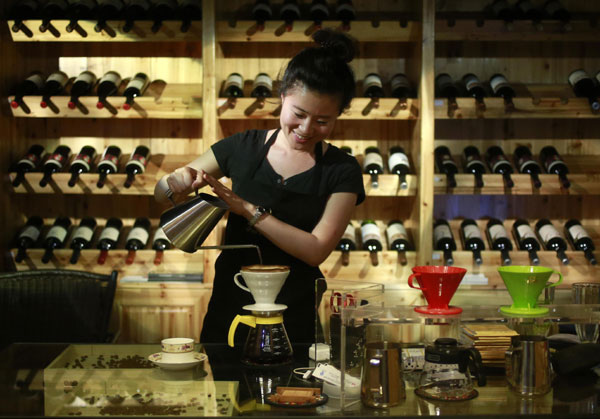
A woman makes coffee in a coffee shop in Pu'er, Yunnan province, a major coffee growing area in China. Feng Yongbin / China Daily |