Green energy 'needs right technology'
China's commitment to building green energy generating capacity is real, but it needs the support of technologically mature economies to make sure that it invests in the right projects and that the most advanced solutions are rolled out, a leading UK industrial expert says.
"There are too many examples where compromise solutions have been implemented that don't provide the necessary environmental benefits because quality standards are too low or previous generation technology has been used," says Chris Rudd, professor of mechanical engineering at the University of Nottingham.
Rudd says the situation is improving, but because of the scale of China's demand, any mistakes can be hugely expensive and time-consuming to rectify.
|
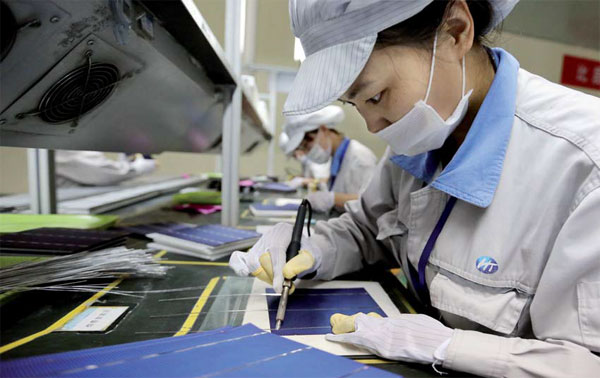
A photovoltaic power generation company in Lianyungang, Jiangsu province, specializing in the Europe market. China is the world's largest manufacturer of photovoltaic modules and wind turbines. Si Wei / For China Daily |
China's state-owned enterprises are facing a major challenge in reinventing themselves to support China's ecological endeavors and its new role in the world economy.
A recent Beijing Youth Daily report shows that about 21 percent of the country's listed SOEs registered losses in the first three quarters of 2015, with the worst 10 losing a total of about 13.5 billion yuan ($2.05 billion, 1.89 billion euros).
In order to enhance productivity and to further eliminate outdated procurement and management practices, Rudd suggests the pace of change will need to accelerate.
"No single measure will rescue this major part of the national infrastructure, but a combination of mixed ownership, management changes, business spinoffs and overseas partnerships will help to refresh the portfolio and enhance their readiness to embrace change, new technologies and market responsiveness," Rudd says.
As major providers and consumers of energy and other natural resources, Rudd believes the SOEs are critical in delivering a green future, and accelerating reform in the sector is of paramount importance.
"It should also be borne in mind that these are huge employers in China, both directly and via their supply chains. Safeguarding a major segment of the Chinese labor market is a further consideration that makes their upgrading and longevity a top national priority," adds Rudd.
Europe, and UK in particular, have a thriving green-tech industry and there is already a strong basis for collaboration with China, considering technology developments in R&D partnerships, manufacturing facilities and design services.
"The availability of private and sovereign capital in China means that win-win partnerships can be formed, with investment in capital-starved overseas businesses and projects, while Western technology can be deployed economically in China's huge domestic market," says Rudd, adding that there are great examples of this with UK's next-generation green energy projects in nuclear and tidal power schemes.
During the Paris climate summit in December, President Xi Jinping pledged to reduce CO2 per unit of GDP by 60 percent to 65 percent from the 2005 level, and raise the share of nonfossil fuels in primary energy consumption to about 20 percent by 2030.
Xi said China would adopt new policy measures to improve its industrial mix, build low-carbon energy systems, and develop green buildings and low-carbon transportation on the basis of technological and institutional innovation.
As a direct result, innovation and green development have been put forward as two of China's major themes in its 13th Five-Year Plan (2016-2020) proposal. China's refocusing on its development strategy brings about great potential opportunities for the UK and European businesses.
Britain has particular strengths in engineering and design consultancy, and it has outstanding R&D capabilities, which will be relevant as China upgrades the energy efficiency of its buildings and implements "smart city" concepts for the future, says Neil Hirst, senior policy fellow for climate change and the environment at Grantham Institute, Imperial College London.
"Imperial College, where I work, collaborates with many Chinese research institutions and trains many Chinese students in science and technology," Hirst adds.
The scale of China's adaptation to a lower carbon future will certainly offer widespread opportunities to businesses in the UK and in Europe that are following the same route, he says.
China is now the world's largest manufacturer of photovoltaic modules and wind turbines, says Hirst, adding that in some areas it has the most advanced technology, but there are also many technologies where Europe is at the cutting edge.
"There will be major opportunities in renewables, including wind and solar, but also in modernization, including efficiency improvements, of a wide range of manufacturing industries, and conventional power plants," Hirst adds.
wangmingjie@mail.chinadailyuk.com