Reducing waste can boost food security
More cold storage and better roads can cut post-harvest losses, but consumers need to be less profligate
During the 13th Five-Year Plan (2016-20), China intends to pursue a new development mode that is "higher in quality, more efficient, fairer, and more sustainable". Agriculture will be fundamental to this, given its significance to food and environmental security.
China produces about 75 percent of the combined value of production of Organization of Economic Cooperation and Development countries. Globally, it is the largest producer of food such as potatoes, wheat, tomatoes, rice and apples. Its own agricultural products are supplemented by imports of agrofood products from all over the world to ensure food security.
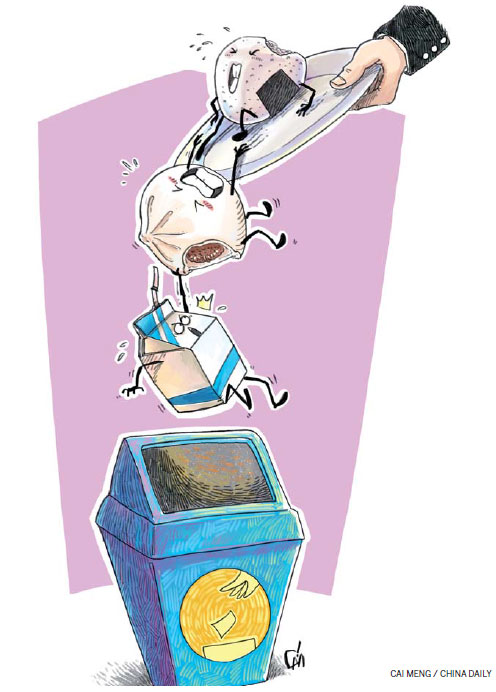
But food security not only means enough food is available, but also that the food that is available is not overconsumed or wasted. At present, industrialized Asia (China, Japan and South Korea) contributes 28 percent of the food wasted in the world, an estimated 1.3 billion metric tons a year.
For industrialized Asia, three stages of the supply chain need special attention: post-harvest handling and storage, distribution and consumption. The handling and storage stage accounts for 20 percent of the food wasted in the region, while another 14 percent of food is lost at the distribution stage, and 31 percent is wasted during consumption.
That vegetable losses in industrialized Asia account for about 11 percent of global food losses is of special concern, as this region accounts for more than 50 percent of global production and consumption.
According to the OECD, perishable foods such as fruit and vegetables show high post-harvest losses in China, an estimated 15 percent and 10 percent respectively. This, and the fact only a small percentage of fruit and vegetables are processed, contributes to the high losses.
However, statistics are not always very reliable. For example, for potatoes, some studies indicate that the post-harvest physical waste is 20 percent, while others claim only 7 percent.
Geographically, there are higher post-harvest losses in northern China compared with the south.
According to a survey by the State Administration of Grain, the average household grain storage loss is 10.2 percent in northeastern provinces, 8.8 percent in northwestern provinces, 7.4 percent in the middle and lower reaches of the Yangtze River, and 5 percent in the Yellow River-Huaihe-Haihe Plain. This difference can be explained by many factors, including climatic conditions and planting practices. More cold storage and better road infrastructure will reduce post-harvest losses over time.
With the increasing affluence of Chinese consumers, food waste at the consumption stage is steadily increasing. Yet the majority of food waste at this stage occurs in restaurants, not by households, unlike in the developed world. In the catering and restaurant sectors, an average of 10 percent of food is wasted. Many times, over-ordering, regarded as a sign of respect and generosity to guests, leads to unnecessary waste.
The Chinese leadership has placed a high priority on food security. It can be significantly assisted by progressively ensuring that any food produced or imported is actually eaten, not wasted. China does not have much land and water to increase its food production significantly, so a comprehensive framework that reduces food waste and ensures food security will be beneficial over the long term for China and the world.
Cecilia Tortajada is senior research fellow at the Institute of Water Policy of the National University of Singapore; Matthew J. Kastner is a graduate student at the university, and Asit K. Biswas is a visiting professor. The views do not necessarily reflect those of China Daily.