Country's biggest illegal ivory haul destroyed
Sri Lanka's government on Tuesday destroyed its biggest illegal ivory haul in the first public crushing of poached tusks in South Asia, intended to send a stark message to smugglers.
The international trade in ivory has been banned inmost of the world since 1989, but illegal smuggling persists in many parts of Asia where ivory is highly prized for medicinal and decorative uses.
Sri Lanka said it was sending a strong message by destroying the haul, more than 350 tusks weighing about 1.5 tons that were displayed at the Galle Face promenade in the capital before being fed into a crusher to be sent to an industrial furnace.
|
A customs officer holds part of a cache of 'blood ivory' before it was destroyed in Colombo on Tuesday. Ishara S. Kodikara / Agence France-Presse |
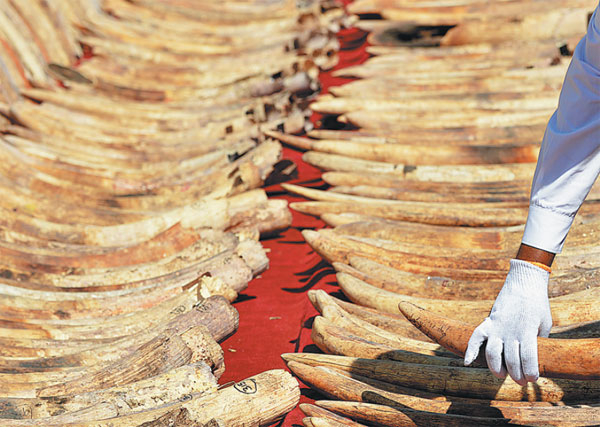
The haul, which came from African elephants slaughtered for their tusks, was seized at Colombo's port nearly four years ago en route to Dubai.
"There are some very small tusks which would have come from baby elephants," Colombo Customs Director Udayantha Liyanage told reporters.
"We are trying to demonstrate that there is no value for blood ivory. ... It is horribly cruel and the elephants suffer for a week before they die," he said.
Blood ivory is a term used by activists to describe tusks that are obtained illegally by slaughtering elephants.
The ivory came from northern Mozambique and Tanzania and transited through Kenya to Sri Lanka on the way to the United Arab Emirates, said Secretary-general of the Convention on International Trade in Endangered Species, John E. Scanlon.
Scanlon, who was present for the destruction, said Sri Lanka's action demonstrated it will not tolerate the illegal trade.
"This shows the effectiveness of Sri Lankan customs in detecting this contraband in transit," he said.
The number of African elephants killed for their tusks peaked in 2011, according to CITES, with about 30,000 animals slaughtered.
However, he said many African nations were cracking down on the illegal trade and that as a result, blood ivory was becoming a low-profit, high-risk venture for smugglers.
The organizers observed a two-minute silence for the slain elephants before Buddhist, Hindu, Christian and Muslim leaders performed funeral rites for the animals.