A wealth of evidence in tomb mystery
Gold haul suggests the coffin may contain a deposed emperor's body, but experts want more proof
Based on what has been unearthed so far in the ongoing excavation of a 2,000-year-old tomb in southern China, archaeologists could be about to open the coffin of an emperor who enjoyed one of the shortest reigns in Chinese history.
Huge hauls of gold plates and ingots, exquisite carriages, a jade seal, and bronze musical instruments decorated and positioned in a royal manner suggest this is the final resting place of Liu He (92-59 BC).
|
Experts and archaeologists examine condition of a 2,000-year-old tomb in Jiangxi province of a deposed emperor of the Western Han Dynasty (206 BC-AD 24). Guo Jing / For China Daily |
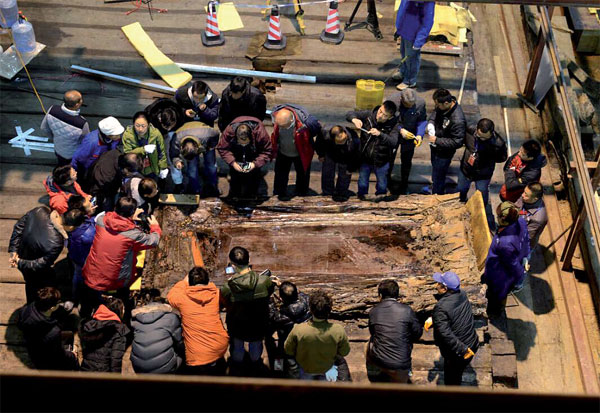
"So far all the clues point to him," says Yang Jun, head of the archaeological team that is working around the clock to recover relics at the site, which is about 90 minutes' drive from Nanchang in Jiangxi province.
Liu He was an emperor who ruled for just 27 days during the Western Han Dynasty (206 BC-AD 24). He was later banished to the south and given the title Marquis Haihun.
"Some of our findings (during the excavation) bear the typical traits of the Han royal family," Yang says, such as a jade seal inscribed with "Liu", the royal family name.
Historians say they also have found evidence backing the theory by comparing writing found on some of the bronzeware, as well as the techniques used to create several other items, with ancient records.
Yet despite the evidence, some experts, including Xin Lixiang, a leading authority, who is observing the excavation, have said they are holding out for definite proof, such as personal belongings or a seal carrying Liu He's name.
That should come when the coffin is finally opened, but that could take time. Due to concerns over conditions at the site, the archaeology team said on Dec 30 that the entire inner section of the tomb will be moved to a research center for further study.
Prior to that announcement, Xu Changqing, director of the Jiangxi provincial Archaeological Research Institute, told China Daily the archaeology team will move the inner coffin and the wooden bed beneath it to a research lab nearby.
Valuable findings
The tomb is a unique specimen. Discovered in nearly pristine condition, it contains a massive amount of treasure as well as information that, potentially, could be of immense historical importance.
In all, the burial complex covers 40,000 square meters, which includes the tombs of the Marquis Haihun, his wife and several others. Work to excavate the site began in 2011 after the local authorities received reports of a tunnel dug by grave robbers. The wife's tomb had been entirely looted, but the tomb now suspected to hold Liu He was untouched.
Archaeologists have found 20,000 relics so far, including 6,000 in the outer chamber of the marquis' tomb, which they began to excavate only in October. Hoof-shaped gold ingots (the currency of the time), gold plates and copper coins have been found throughout the site.
Some of the gold ingots found in the tomb were inscribed with the ancient Chinese characters for shang (up), zhong (middle) and xia (down), on which researchers are still working on their meaning.
So far, the dig team has unearthed 378 gold items weighing a combined 78 kg. Based on the current price of gold, the treasure is worth about $2.7 million, not counting its historical value.
"The gold plates (each about 1 kg) served as gold reserves for the ruling king or marquis," says Xin, who is heading an on-site team of experts.
"The finds reflect a trend of showing off wealth," adds Wang Zijin, a history professor with Renmin University of China, who specializes in the Han Dynasty (206 BC-AD 220). "It could also be a reflection of the area's prosperous economy at the time."
At the time of Marquis Haihun (Liu He was the first of four generations to hold the title), many people from the north migrated to areas along the Yangtze River, as the economy in the south was starting to boom.
Another thing that has peaked people's interest is the discovery of 10 bronze caldrons, or ding, which at the time were the preserve of high society. One vessel is inscribed with the ancient characters for nan and chang, which could make it the earliest artifact to carry the city's current name, Nanchang.
Nearly 3,000 well-preserved bamboo strips, used to keep records, were also discovered. Experts from Peking University are attempting to interpret the ancient script.
A portrait of Confucius was also found in the tomb and could be one of the earliest images of the philosopher.
"The large amount of gilded ware, lacquer, bronze vessels decorated with gold and silver, and musical instruments shows us the superb craftsmanship and techniques used during the Western Han Dynasty," says Xu at the Jiangxi Archaeological Research Institute.
Wang adds that the articles also reflect the artistic tastes of Han nobles.
The remains of caterpillar fungus found inside the tomb could also change people's understanding of the medicine used in those times, while cooking pots and utensils resemble what is used today to make hotpot dishes and distill alcohol.
"The quality of the artifacts can also be a crucial criteria when judging the prosperity of a society," Wang says.
Contact the writers through leixiaoxun@chinadaily.com.cn