Tai chi changes the face of quaint, quiet farming village
Birthplace of the popular martial art strives to preserve its traditional character while embracing newfound prosperity and the challenges of growth
Once hidden along the dusty rural back roads of Wenxian county in Henan province, the village of Chenjiagou, the birthplace of the martial art of tai chi chuan, now stands tall among carefully tended corn and wheat fields.
Familiarly known as Chen Village by the growing number of tai chi enthusiasts worldwide, Chenjiagou has undergone, and continues to experience, huge changes that are transforming the countryside surrounding this 600-year-old village in Central China.
|
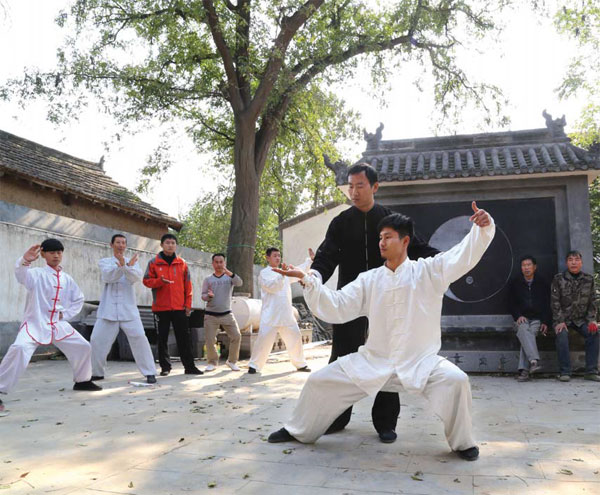
Students practice tai chi at a martial arts school in Chenjiagou, Wenxian county, Henan province. Xu Hongxing / For China Daily |
A new hotel and storefronts have sprung up. A towering, recently built museum can be seen from the distance as you approach the village, where countless lanky trees lining the roadsides were once the only landmark. A sprawling new training hall/competition arena greets visitors before they reach the main gate of the village proper. There's even talk of building a hospital and a tai chi university, and of creating a lake that would be fed, in part, by the nurturing waters of the nearby Yellow River.
Yet, amid these great winds of change, the heart of the old village, like the calm eye of a hurricane, sits untouched by the passing of time. Whether it will remain so is a question that's foremost on the minds of those shaping Chenjiagou's future.
As villages across China are encouraged by the central government to take advantage of their unique cultural treasures to attract tourism revenue and be more self-supporting, Chen Village is well ahead of the curve. But it now faces a new stage in its development - the challenge of increasing, and sustaining, its growth and newfound prosperity.
"The village has a bright future once more infrastructure is built," says Zhang Jintai, deputy chief of Wenxian county, of which Chenjiagou is a part. Construction is already underway, or completed, on tour bus stations, parking lots and hotels, he says, and the county has designated about 35 square kilometers in and around the village as a tai chi cultural zone.
But the county government is also keen on safeguarding the heart of the village. "We must preserve the old village, the old houses of important people," Zhang says.
While their vision and experiences differ, top Chen family tai chi masters and local officials who talked to China Daily agrees on one point: The further development of Chen tai chi and the village where it was born will depend on cooperation and coordination among the many stakeholders in Chenjiagou's future. These include the villagers, the traditional Chen family council, planners, the local and regional tourism industry, different levels of government and, in particular, the 19th-generation villagers known worldwide to tai chi enthusiasts as the "Four Tigers of Chen Village" - tai chi grandmasters Chen Zhenglei, Chen Xiaowang, Zhu Tiancai and Wang Xi'an.
While the farming village with a population of 2,700 chiefly grows wheat and corn, its biggest recent harvest has been the income generated by its rich tai chi culture.
Chenjiagou at one time was a village of great hardship, poverty and struggle. Its fortunes began changing in the early 1980s, when a group of Japanese visitors was so impressed by the village's traditional tai chi, created in the 1600s by Chen Wangting, that they went home and began spreading the word about the little-known place.
"The small village then became famous very quickly," says Chen Zhenglei. "This aroused the government's attention, and in the past 10 years Chenjiagou has developed the fastest." He says private investment is lining up to assist with carrying out development plans for the village.
Tai chi Grandmaster Chen Xiaoxing, 62, remembers well what the village was like just before its rise to fame. Chen, the younger brother of Chen Xiaowang, has long run a tai chi school just inside the village's main gate that is popular among locals and foreigners alike.
"Before 1981, this area was tombs and farm fields, but mostly vacant land," Chen says. "There has really been a lot of change."
In 1981, with the help of the local government, Chen Xiaoxing built the school. In 2000, he rebuilt it by himself. It now covers just shy of 10,000 square meters and has about 80 dorm rooms with toilets and showers - features that make them popular among foreign visitors - as well as simpler dorm rooms for local students.
Contact the writers at jameshealy@chinadaily.com.cn