TPP no better than 'imperial preference'
The US and 11 other countries in the Pacific Rim reached a basic agreement on the Trans-Pacific Partnership on Oct 5.
The motive of some decision-makers involved in the TPP is to seek political gains by writing new global trade rules. Since US President Barack Obama might become one of the US presidents with least political legacy, no wonder he is in urgent need of political achievements.
Moreover, the latest poll in Canada shows that as the Oct 19 election approaches, the ratings for the Conservatives, the New Democratic Party and the Liberal Party are all close. Given the increasing pressure Prime Minister Stephen Harper and his Conservative government have faced over the past nine years, it is no wonder it hopes to reach a basic agreement on the TPP before the election to bolster its support.
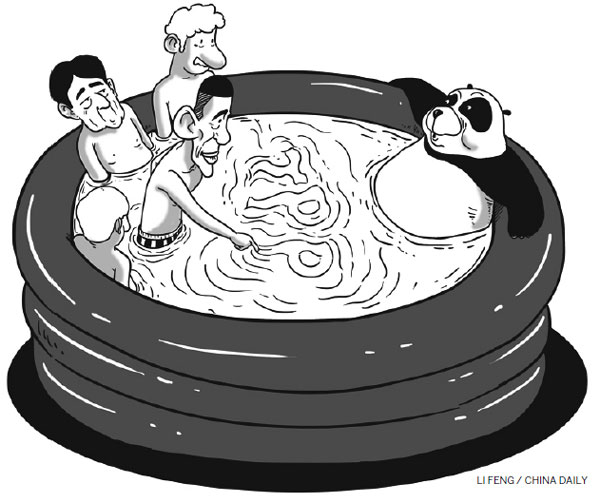
There is no chance of the TPP isolating China from international trade and blocking its economy as some have stated. Not only because there will be long legislative procedures in the countries concerned to ratify the agreement, but also because there is a long interim period before the zero tariff in the agreement comes into effect.
As China has become the world's largest manufacturing country and the only country possessing all industrial sectors categorized by the United Nations, the size of the 11 countries involved in the TPP, excluding the US, determines they cannot drain China's industrial chain. Also, China rather than the US is the biggest trade partner of most of the TPP member countries.
Apart from integrating the domestic market and launching the Belt and Road Initiative, China has also initiated and deepened negotiations on regional free trade. These include the China-ASEAN Free Trade Area, the China-South Korea Free Trade Area, the Regional Comprehensive Economic Partnership and the Free Trade Area of the Asia-Pacific. It has also established domestic free-trade zones in Shanghai and Tianjin, and Guangdong and Fujian provinces. For the aforementioned reasons, it is the mainstream proposition of the Chinese government to adopt an open attitude and respect the co-existence of the TPP and other regional free trade arrangements under WTO rules.
One thing that should be noted is whether the TPP is a new form of "imperial preference", which was established by the United Kingdom in the 1930s when it lost its ambition to maintain global free trade and resorted to regional economic integration and preferential trading arrangements within the Commonwealth. Although this eventually failed.
Be it launching the negotiations on the TPP, or reaching agreement on the Transatlantic Trade and Investment Partnership with Europe, all the US' moves have the intention of maintaining its hegemony in international trade rulemaking while excluding China. But while they are attacks in tactics they are contractions in strategy from a long-term strategic perspective, considering the circumstances in initiating them has been the global economic downturn that originated from US subprime crisis, which weakened both its soft and hard power. Other countries, including China, that have been less affected and experienced a relative rise on the international stage. These countries are mostly located in Asia. They are viewed as "alien" to the US in terms of political systems, cultural traditions and ethnic composition.
Because of this, the TPP is to a considerable extent similar to the "Imperial Preference" established by the UK.
However, the TPP, if it doesn't violate the current WTO rules, will only have slight impact on China if any, and China will certainly hold an open attitude to it. If it is designed with the purpose of edging China out, it will end up no better than the "imperial preference".
The author is a researcher at the Ministry of Commerce's International Trade and Economic Cooperation Institute.