Reform a real shot in the arm for soccer
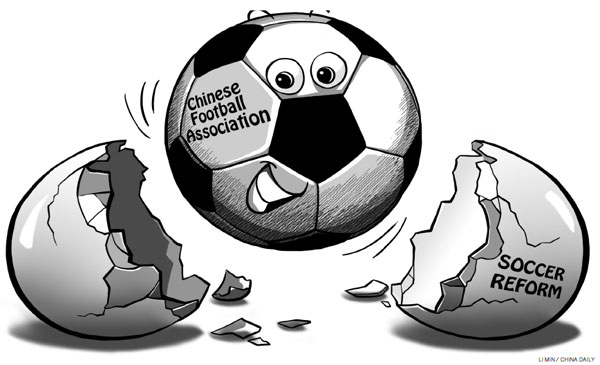
The General Administration of Sport of China issued a long-awaited reform plan for soccer, especially the Chinese Football Association, on Monday that says the association will be separated from the administration soon.
As an administrative department, the CFA is affiliated to the sport administration and does not function as a civil organization, as is generally the case around the world. The reform is aimed at transforming the CFA from a government department to a civil organization.
According to the development history of sports, there must be a clear border between society and the government when it comes to the administration and operation of sports. My recent interactions with two Australian youth soccer teams that were in Beijing to attend an invitational tournament have left me more convinced of the significance and necessity of the ongoing soccer reform in China, a country with the largest number of soccer fans in the world.
A core spirit of the reform is that the government should respect the laws of sports and the market, and relax its tight grip on the administration of sports.
China focuses on good coaches, talented players and big government inputs in soccer programs. Yet the Australian government has adopted a more inclusive plan to promote all kinds of sports from the school level. Youths can choose the sports they like most, and their interest is considered their best mentor. As such, children who choose to play soccer are the most committed to soccer. In contrast, all students in some Chinese schools are forced to play soccer just because of a government policy aimed at promoting the game.
Unlike their Chinese counterparts, Australian children who love playing soccer seldom receive collective training in schools or attend special soccer camps under the aegis of the government. Instead, amateur community soccer clubs in Australia play an important role in organizing children's training and tournaments. The funding comes from soccer-loving children's families, amateur (and other) clubs and the government, not the schools because that would be unfair to students not playing soccer.
This is not to say that Australian schools don't care about sports. Actually, the level of and facilities for sports are important criteria to judge a school's quality in Australia, and college students majoring in sports have many career opportunities. On the other hand, majoring in sports in China is mostly a makeshift choice for students who are not good in academics.
The young Australian soccer players visiting Beijing seemed confused when I asked them whether playing soccer has had an impact on their studies, for they believe playing sports is as important as spending time on books.
Colleges in many universities have quotas for sports talents. But in China, the provision of enrolling students good at sports in colleges even if they don't have the qualifying scores has been misused by some corrupt education and sports officials.
The mushrooming of professional soccer clubs in China since 1994, when the three-level Chinese soccer league started, can be attributed to the social appeal and market demand for soccer. In this sense, the CFA should act as a watchdog rather than an almighty power controlling every aspect of soccer.
Hundreds of millions Chinese soccer fans dream of seeing their country's soccer team and players play at the global level, instead of struggling even at the regional level. The reform, if well implemented, will be an important step toward making this dream come true.
China's soccer reform demands the joint efforts of different parties, especially the market and society, which should take the onus of providing quality training to and cultivating young talents, for example, through a multi-tier but healthy and professional soccer league. In this regard, the government has to introduce more professionalism and expertise in planning, policymaking and financing. And schools and parents must try to instill the love for sports among children and thus allow them to enjoy playing sports.
The author is an official of Chinese Student Sports Federation.