Abe shies away from a direct apology
Japanese primeministermentions key words, but only when quoting others
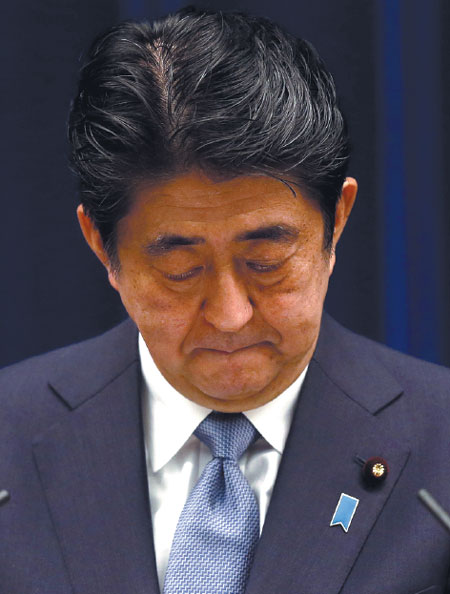
China is urging Japan to repent in concrete terms after Japanese Prime Minister Shinzo Abe attempted to downplay his country's aggression in a long-awaited statement marking the end of World War II.
In a statement released one day ahead of Saturday's 70th anniversary of the end of the war, Abe did mention the awaited key words - "aggression", "apology", "colonial rule" and "deep remorse".
But he mentioned them quoting or summarizing, without directly stating his own ideas.
"Japan has repeatedly expressed the feelings of deep remorse and heartfelt apology for its actions during the war," Abe said. "Such positions articulated by the previous Cabinets will remain unshakable into the future."
In some parts of the speech, he tried to retell history without stating the nature of the war was aggressive, analysts noted.
"In countries that fought against Japan, countless lives were lost among young people with promising futures. In China, Southeast Asia, the Pacific islands and elsewhere that became the battlefields, numerous innocent citizens suffered and fell victim to battles," Abe said.
Seoul-based Yonhap News Agency said that Abe "did not offer his own apology clearly, although he expressed 'profound grief' over war dead".
Ruan Zongze, vice-president of the China Institute of International Studies, said that Abe seemed to talk insincerely when mentioning the key words, and "the new position came from pressure, both domestically and internationally".
"If Abe continues pushing his radical right-leaning agenda, he will contradict his previous pledges further frustrate the international community," Ruan said of the radical security bills discussed in Japan's upper house.
Yang Bojiang, deputy director of the Chinese Academy of Social Sciences' Institute of Japan Studies, said that given Abe's revisionist outlook on history, Friday's statement "could be interpreted as a sort of concession" to Japan's pacifists.
Yang added that Abe's speech "is a step backward, indeed" compared with the Murayama Statement delivered by former Japanese Prime Minister Tomiichi Murayama on the 50th anniversary of the end of the war in 1995.
Debate was prompted by Abe's remark that "we must not let our children, grandchildren and even further generations to come, who have nothing to do with that war, be predestined to apologize."
Abe also said that "nearly 3,000 Japanese children left behind in China were able to grow up there and set foot on the soil of their homeland again".
"Abe is trying to look friendly in order to improve Japan's relationship with China by making such a remark," Yang commented.
During the war, Japan forced Asian women into sexual slavery to please the Imperial Japanese Army. However, Abe avoided using the widely known euphemism "comfort women" by stating that "the dignity and honor of many women were severely injured during wars in the 20th century".
Wilson Lee Flores, a columnist at the Philippine Star and a college professor, said the statement "seemed like a public relations speech" and "Japan's future is uncertain because Abe is pushing to change its peaceful Constitution even though over half the population disagrees with him".
"I believe the world, and Asia's victimized countries, should judge Japanese leaders by their sincere actions - like correcting wrong museum stories, revising wrong history textbook accounts, issuing an official government apology and by paying 'comfort women'," he said.
Contact the writers through zhangyunbi@chinadaily.com.cn
|
Japanese Prime Minister Shinzo Abe delivers a statement in Tokyo on Friday marking the 70th anniversary of the end of World War II. He acknowledged Japan had inflicted "immeasurable damage and suffering" on innocent people but said generations not involved in the conflict should not be burdened with continued apologies. Toru Hanai / Reuters |