Chinese classic crosses cultural barriers as ballet
Can a German-Nigerian choreographer create a new play based on China's most celebrated imperial love story?
Patrick de Bana, the choreographer who has taken up the challenge, is confident he can - and so is Shanghai Ballet, which gave him the commission.
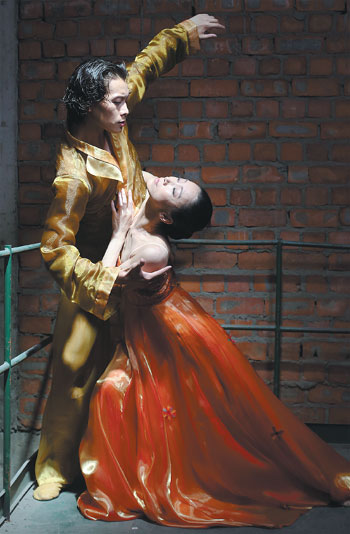
Echoes of Eternity is the first modern ballet adaptation of the poem Changhen Ge (The Song of Everlasting Regret) by Bai Juyi (AD 772-846), which tells the story of Yang Guifei and Emperor Xuanzong of the Tang Dynasty (AD 618-907). The production will premiere at Shanghai Grand Theater on July 30.
De Bana says his confidence comes from the fact that he is a child of the world, born in Hungary to a German mother and Nigerian father, and he believes that when an author writes down a story, poem or any other literary work, it is meant for the whole world to read. It's a love story, adds the dancer-turned-choreographer, and "love has no passport or nationality. It's universal."
De Bana studied at Hamburg Ballet under the direction of John Neumeier and Truman Finney, and joined Bejart Ballet Laussane in 1987. As a principal dancer, he left for the Compania Nacional de Danza of Spain in 1992, then created his own company in 2003, the Nafas Dance Company.
He's no stranger to Shanghai Ballet, which invited him to create a dance-theater production of Jane Eyre in 2012. The result: a particularly impressive presentation of Bertha, the mad wife of Rochester, Jane's employer and lover, in the course of the dramatic entanglement between the three lead characters.
While in Shanghai, de Bana read the story of Changhen Ge in English, and proposed adapting it for ballet theater.
Shanghai Ballet liked the idea of telling the Chinese story through Western ballet. The poem Changhen Ge has inspired theatrical, literary, artistic and other adaptations for centuries, but de Bana intentionally ignored those to remain true to the original poem.
In addition to the emperor and his favorite consort, Yang Guifei, de Bana has added a new role in the ballet production, a moon fairy.
"I didn't create the role, actually," he says.
"You would find descriptions about the moon fairy in the original poem."
The fairy witnesses the whole story from high above, as her existence transcends time and space, symbolizing love, freedom and eternity.
In the original story, Yang was the emperor's favorite guifei (the highest rank for imperial consort of the time), famous as a plump beauty in Chinese history. The emperor was so fascinated with her that he neglected his duties.
Rebellion broke out and drove the emperor out of the capital. The guards blamed the Guifei and her family for the rebellion and forced the emperor to have her strangled to death.
Wu Husheng, a principal dancer with Shanghai Ballet, will take the role of the emperor. He appreciates the way de Bana inspired dancers to present their own understandings of the circumstance and characters.
China's male ballet dancers traditionally retire at around 30 years old, says Wu Bin, who will act as a marshal in the play.
"Working under the guidance of Patrick has enabled us, inspired us," he says.
Wu and other principal dancers are all in their early 30s, and Wu says the choreographer has tapped their experience to extend their artistic lifespans.
De Bana has spent months training the dancers in the basic movements. The creative process has been so demanding that Chen Yan, the lead ballerina, had to be hospitalized until after the premiere.
"We have several candidates to replace her, but we are sure she will be the perfect dancer for the role and will be able to dance," says Xin Lili, director of Shanghai Ballet.
In October, Echoes of Eternity will be staged in Beijing and then will run at the China Shanghai International Art Festival.
zhangkun@chinadaily.com.cn
|
A scene from Echoes of Eternity, the first modern ballet adaptation of the poem Changhen Ge, a love story between Yang Guifei and Emperor Xuanzong of the Tang Dynasty (AD 618907).Provided To China Daily |
(China Daily 07/29/2015 page18)