China's kungfu fight against climate change
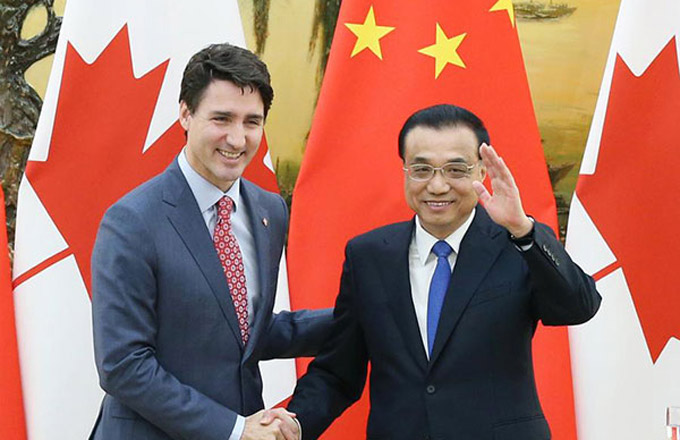
On June 30, China submitted to the UN secretariat a report on its intended nationally determined contribution (INDC) post-2020 climate actions during Premier Li Keqiang's visit to Brussels and Paris, which will host the UN climate change conference in December. The timeframe of China's emissions peak was part of the China-US Joint Statement last November, but the INDC is a full set of green kungfu moves to realize the Chinese Dream.
No country can accurately predict the future - a move in kungfu called "the remorse of brouhaha dragon", which points to positive outcome leaving room for maneuver - but China will do its best to achieve the target.
The first moveis to decouple carbon emissions and the economy by 4 percent every year. China will lower its carbon dioxide (CO2) emissions per unit of GDP by 60 to 65 percent by 2030 from the 2005 level, which means the carbon intensity will be reduced by 3.6 percent to 4.1 percent in 25 years.
The goal can be achieved before schedule, as was the case for the 12th Five-Year Plan (2011-15) - the carbon intensity is expected to be lowered by more than 45 percent by 2020.
The second move is energy revolution. The increment in non-fossil energy generation is expected to be more than one-third of the world's total in 25 years. Installed capacities of 60 GW and generated power of 250 TeraWatt are required every year by 2030, among which the installed capacities of new nuclear, solar and wind power should be about 200 GW (220 nuclear reactors, 14 new ones every year), 300 GW (17,000 solar farms, 1,100 new ones a year) and 400 GW (22,0000 wind turbines, 14,000 new a year). And the total investment in non-fossil fuel is likely to reach about $2.5 trillion.
The third move is afforestation of an area as large as Beijing a year. Here, the most direct and simple move is to expand the carbon sink, and accelerate the recovery of the damaged environment. Last year, its forest stock increased by 2.19 billion cubic meters. In actual terms, its forest area has increased by 21.6 million hectares since 2005, that is, 13 times the size of Beijing. China's forest stock is likely to increase by 4.5 billion cubic meters by 2030, compared with the 2005 level.
The fourth move in China's kungfu fight against climate change is to ensure the emission peak is achieved as early as possible, that is before 2030. But emission peaks were not achieved even by developed countries uniformly, and hence they can divided into three groups:
Red Label - This group comprises countries such as the United States, Canada and Australia. Their per capita CO2 emissions usually stayed above 15 tons, and most of them reached their emission peaks after 2005. So their peaks are deemed unstable.
Yellow Label - This consists of countries like Germany, the United Kingdom and Belgium. The per capita CO2 emissions in these countries had been more than 10 tons, but they are lower now. Since most of them reached their peaks in the 1970s, they are considered stable and sustainable.
Blue Label - This group comprises countries such as Japan, Italy and Spain. Their per capita CO2 emissions stayed below 10 tons. But since most of them reached their emission peaks after 2005, they are deemed unstable as well.
If we take the level of economic development as the benchmark and if, according to the Organization for Economic Cooperation and Development's projection up to 2060, China remains a Red Label country, its emissions will peak around 2040. But as a Yellow Label country, China's emissions will peak by 2025, and as a Blue Label country, its emissions will peak around 2035.
Obviously, China should take all measures to avoid being in the Red Label group by taking advantage of the advanced technology and greener development models. By doing so, it will be part of the Yellow Label countries and contribute more to the international community.
But we have enough reason to believe that China is on way to achieve its emission targets earlier, in historical terms, than developed countries.
The author is deputy director of the Strategy and Planning Department of the National Center for Climate Change Strategy and International Cooperation.