Unraveling the mystique of the Chinese banquet
|
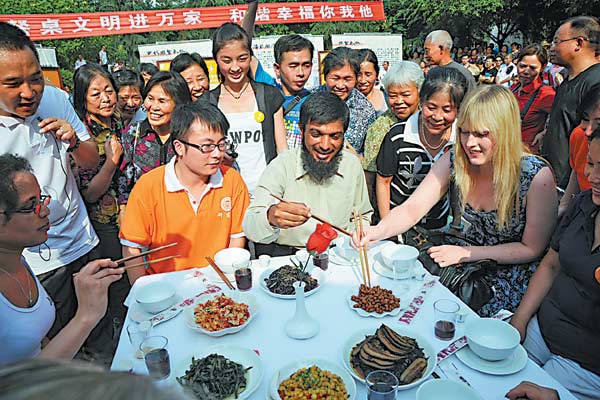
A lesson in Chinese dining etiquette and the use of chopsticks in Chongqing. Provided To China Daily |
Classes help executives do business across cultures, Chen Yingqun reports.
Like many foreign businesspeople in China, John Bruijnooge knows there is much more to a Chinese banquet than just sitting down for a meal.
"There are a lot of unwritten rules, many I don't know about," says the Dutch executive, who regularly attends dinners with government officials and corporate executives around China.
"I want to know how to behave so I can improve my relationships," he says. "I'd really regret it if I made a big mistake and damaged a relationship."
To prevent that happening, Bruijnooge paid 2,500 yuan ($410) in May to attend a one-day course at Institute Sarita, a private finishing school in Beijing.
Founder and principal Sara Jane Ho says dozens of Western executives have turned to her school's etiquette classes to learn the art of surviving a Chinese business banquet.
Of all the customs, she says, "the way people toast each other is definitely the most confusing and yet intriguing for Westerners".
In the West, people tend to stay seated during a business dinner, often because the seating has been arranged so the "right people" will have the chance to converse, Ho says. But in China, as soon as the first dishes arrive, people stand up, take a drink in hand and start to toast other guests while walking around the room.
"It's very disconcerting for foreigners," she says.
"They're not sure if they should be doing the same thing, who they should toast, when they should toast, and what they should say, or whether they should drink seated or standing up. It's where foreigners feel most uncomfortable.
"Chinese businesspeople are nervous about Western business lunches, but Westerners are equally nervous about Chinese business banquets."
Ho founded Institute Sarita in 2013. A former student of Institut Villa Pierrefeu, a finishing school in Switzerland, as well as Harvard Business School, she speaks five languages and has lived in as many countries.
The original aim of the school, she says, was to offer courses to the Chinese elite on international etiquette and protocol such as Western table manners, business etiquette and what clothes to wear.
The idea of advising foreigners on Chinese dining customs came up two years ago, when a senior executive at Cisco Systems asked for etiquette training.
"I thought it was a joke," she recalls. "So I asked her to write an essay to explain why she wanted (the training). To my surprise, it was an extremely well-written and thoughtful three-page essay. I eventually arranged five days of classes for her when she was on a business trip to Beijing."
Since then, her students have come from a range of sectors, including legal, public relations and energy. Most have been senior executives, with some in their 20s and others in their 60s.
The school has also launched an online course for busy businesspeople to work on in their spare time.
Ho, who was born and raised in Hong Kong, says the spirit of etiquette remains the same for Chinese and Western cultures, but habits and customs are constantly changing.
With China's emergence as a global power, some Chinese customs have even been absorbed into international practice.
"More cosmopolitan Westerners are mastering chopsticks, and in fashion and design we're seeing more and more Chinese elements," she says. "Some expatriates are also studying Chinese philosophy, Confucianism and the Chinese tea ceremony."
Rebecca Li, president of Institute Sarita, says a lot of time is spent taking students to banquets and other events for practical classes.
When Institute Sarita opened, it was China's only high-end finishing school, and its courses, which can cost as much as 100,000 yuan, introduced the concept of etiquette training as a niche market. In May, the school opened a branch in Shanghai.
"Our goal is to help Chinese better understand the world, and better express themselves to the world. This is also what the Chinese government is advocating," Li says.
Businesswomen, and the wives and daughters of senior executives and entrepreneurs with business interests overseas, make up the majority of the school's Chinese customers, she says.
"As Chinese businesses are growing, they need to socialize more on an international level."
Some male entrepreneurs have started to study Western etiquette - the clients have traditionally been women - mainly those who are about to be promoted to be global team leaders or who want to take part in meetings abroad.
Finding enough teachers with the right qualities - a cosmopolitan background and familiarity with a broad range of areas, from dressing to table manners, art and languages - is the school's biggest concern right now, Ho says.
Demand in China is big, and to cultivate people's awareness of etiquette, the school offers two-day courses for 8,800 yuan and free introductory lessons.
Contact the writer at chenyingqun@chinadaily.com.cn