China hits out as Abe visits the US
|
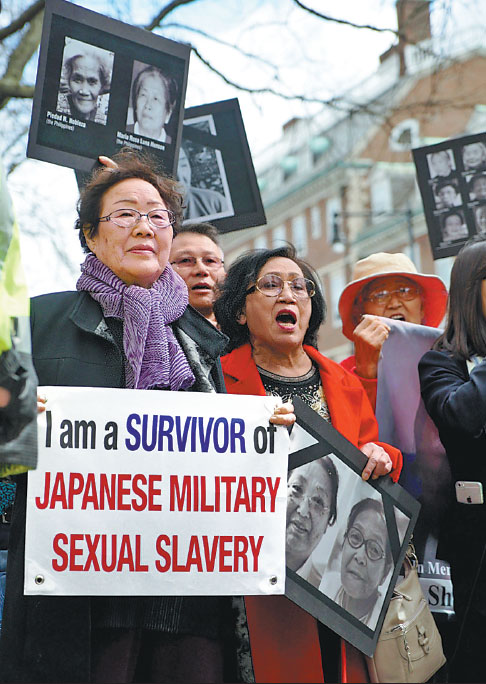
Protesters, including a former Korean "comfort woman", Yong Soo Lee, 88, demonstrate outside the Kennedy School at Harvard in Cambridge, Massachusetts, demanding that Japanese Prime Minister Shinzo Abe apologize for Japan's sexual enslavement of women in occupied countries during WWII. Zhou Erjie / Xinhua |
Washington-Tokyo alliance 'mustn't undermine Beijing's interests or disturb Asia-Pacific region'
Beijing warned on Tuesday that the alliance between the United States and Japan should not undermine China's interests or disturb the Asia-Pacific region.
The warning came as the two allies highlighted territorial issues and Japan's increased security role during Japanese Prime Minister Shinzo Abe's ongoing trip to the US.
US President Barack Obama welcomed Abe to the White House on Tuesday. Hailing the alliance as the "cornerstone" of security in the Asia-Pacific, the two countries vowed to counter threats to "international order" by forging a trade deal and through an expanded security role for long-pacifistic Japan.
Observers said the Obama administration's latest policy agenda shows that the US views China's rising strategic influence in the region as an imminent challenge and that Tokyo has secured more tangible support from Washington during Abe's visit.
US Secretary of State John Kerry said on Monday at a joint news conference that Washington's "commitment to Japan's security remains ironclad and covers all territories under Japan's administration".
Agence France-Presse reported that Kerry clearly included China's Diaoyu Islands within the scope of Japan's administration.
Following a meeting of foreign policy and defense chiefs from both countries, the US and Japan announced new guidelines on Monday for bilateral defense cooperation.
Under these guidelines, revised for the first time since 1997, Japan will have the right to exercise collective self-defense - being allowed to defend not just its own territory, but also the United States and other countries if needed.
Chinese Foreign Ministry spokesman Hong Lei said on Tuesday, "Both the US and Japan have a duty to ensure that their alliance does not infringe the interests of third parties, including China, or the peace and stability of the Asia-Pacific region."
China's territorial sovereignty over the Diaoyu Islands and affiliated islets "remains intact no matter who makes remarks or (takes) action against them", he said. He also said the way in which the US-Japan treaty alliance, formed during the Cold War, develops "deserves attention from all parties".
Abe, the first Japanese leader to visit the US since 2006, was scheduled to address a joint session of Congress on Tuesday.
Yang Bojiang, deputy direct-or of the Institute of Japanese Studies under the Chinese Academy of Social Sciences, said Washington is trying to champion its leadership over the region through the evolving US-Japan agenda, and Japan's influence appears to have increased within the alliance.
"The US is trying to tie Japan tightly to its future strategies.... Also, China's latest strategic proposals with regional influence - including the Asian Infrastructure Investment Bank-have impressed Washington," Yang said.
Ruan Zongze, vice-president of the China Institute of International Studies, said the US is adding weight to Japan's role in its global security strategy. Ruan said, "Washington's security policy support has sent a misleading signal to Abe - that he can gloss over Japan's historical issues."
Washington has said it takes no position over the sovereignty of the Diaoyu Islands. But Obama for the first time officially included the islands within the area of Japan's administration during a visit to Tokyo in April last year, which triggered protests from China.
During a meeting on Tuesday with students at Harvard's Kennedy School in Cambridge, Massachusetts, Abe drew criticism as he again defined "comfort women" - a euphemism for Asian women forced by the Japanese Imperial Army into sexual slavery-as victims of "human trafficking".
In response to a student's question, Abe said, "It's heart-wrenching to think about women who fell victim to human trafficking and suffered unspeakable pain."
Xinhua and Reuters contributed to this story.
Contact the writers through zhangyunbi@chinadaily.com.cn