Cooperation can shape low-carbon future
Turn on your TV. Look at the news. Almost every week you are sure to see images of extreme weather conditions or natural disasters around the globe. All of these disasters cause misery and loss of human life as well as billions of yuan in damages.
Climate change is not just happening to others elsewhere in the world. Last winter was the warmest in Beijing since 1951. In the north, China is battling drought and desertification; in the south, extreme weather is on the increase.
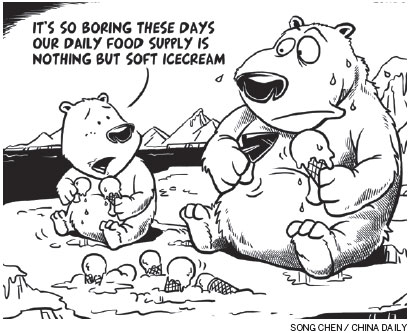
The risks of uncontrolled climate change are serious: rising sea levels that threaten to flood coastal cities; increasingly extreme weather that jeopardises food production; and worsening water shortages.
The serious air pollution which troubles many cities worldwide shares a major common cause with climate change: burning fossil fuels.
The Chinese government recognises the threat from climate change, calling it "one of the greatest threats facing humanity", and saying it is in China's own interests to address this problem.
The European Union and China are both taking action. China is the world's largest investor in clean and renewable energy. Dependence on coal is falling and the rate of growth in greenhouse gas emissions is slowing.
Between 1990 and 2012, we in the EU reduced greenhouse gas emissions by 19 percent, while our economy grew by 45 percent. We have recently committed to reducing EU emissions by at least 40 percent by 2030. We have policies to meet these ambitious targets, while addressing the needs of our diverse members: regions with high and low incomes, high coal and no coal, heavy and clean industry.
There are some concerns that measures to tackle climate change will adversely affect economic growth. This is not necessarily so. Analysis shows that an efficient, low-carbon path is key to future economic success.
The EU, its member states and China are working closely together to increase energy efficiency and renewable energy use and on developing carbon markets, using market forces to reduce pollution cost-efficiently. The EU has ambitious targets for energy efficiency and renewable energy and had the world's first carbon market. China has rapid low-carbon energy development and is making improvements in energy efficiency. China's national emissions trading system will be launched next year and will rapidly overtake the EU to become the world's largest.
However, these efforts are not enough. China and the EU can play a pivotal role in shaping a new future in which we do not have to choose between economic growth and the environment.
China and EU have a future in which our joint efforts to tackle climate change will further drive forward new and renewable energy sources to provide sustainable and safe energy; a world in which we share the best of our expertise to safeguard the climate and address air and water pollution; and in which more and more people work in clean sectors of the economy.
This is a crucial year for global climate negotiations, with a key meeting to take place in Paris at the end of the year aiming to reach an agreement on global action. If we are to stand a chance of keeping global warming within 2 degrees above pre-industrial levels and avoiding catastrophe, an ambitious, legally-binding agreement is needed, covering all countries. A robust agreement will reduce the costs of this transition to a more sustainable future.
In the coming weeks, before the summer, China will set out its contribution to reducing greenhouse gas emissions by 2030 for the Paris agreement. Ambitious targets and policies will send a strong signal to the international community. Other countries are still considering their own contributions, and investors, so that we are moving towards a low-carbon future. Investment decisions over the next 10 to 15 years will determine our success in leading the transformation to a cleaner, more sustainable future for all our citizens for decades to come.
The article is co-authored by the Ambassadors to China of the European Union and the 28 EU Member States of Belgium, Bulgaria, Czech Republic, Denmark, Germany, Estonia, Ireland, Greece, Spain, France, Croatia, Italy, Cyprus, Latvia, Lithuania, Luxembourg, Hungary, Malta, the Netherlands, Austria, Poland, Portugal, Romania, Slovenia, Slovakia, Finland, Sweden, and the United Kingdom.