Paris, Beijing join in fighting pollution
Experts from both sides exchange ideas on dealing with scourge that has hit both cities
One day in March, the air quality index in Paris registered 185, with thick smog enveloping the Eiffel Tower. It was the fourth day that the French capital had been enshrouded in gray clouds, a plight eerily similar to what occurs regularly in Beijing and Shanghai, two of the world's most polluted cities.
But smog is nothing new to the French metropolis. Even before the recent episode of pollution, called Paris' worse since 2007 by the European Environmental Agency, France has been looking to work more closely with China to tackle serious air pollution problems.
|
Karine Leger, assistant director of French air monitor Airparif, says Beijing will host Airparif for a series of training projects. Provided to China Daily |
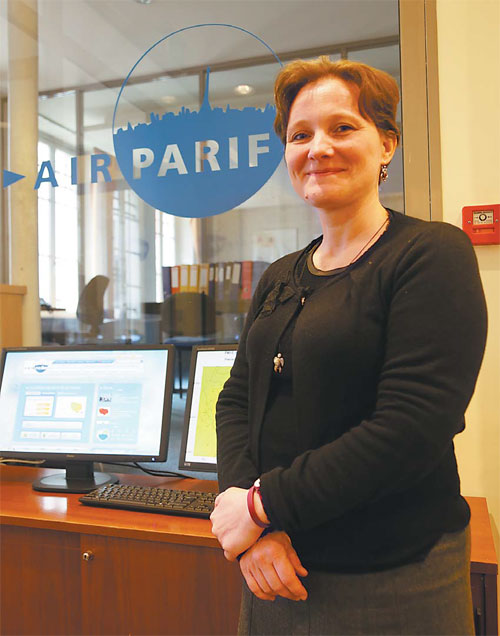
"We'd like to learn from each other see what we can do for people in Beijing concerning air pollution forecasts, and at the same time see if they can help us in this domain", says Karine Leger, assistant director of French air monitor Airparif.
Leger says the nonprofit organization made an agreement last year with the Beijing Municipal Environmental Monitoring Center aimed at improving the detection of air pollutants.
Founded in 1979, Airparif is accredited by France's Ministry of Environment to monitor the air quality of Paris and other cities in the country.
Leger has visited China several times and has done a university thesis on air pollution in China.
"I'm really impressed by what has been done by the Chinese government and its willingness to improve the situation," she says.
Beijing, which has many air monitoring devices and stations, will host Airparif for a series of training projects with the capital's environmental monitoring center to discuss how to better use these devices in accordance with European regulations, Leger says.
"What we could bring to China is share our experience of data analysis and modeling, for example, what kind of data is needed to improve models. We can also show our Beijing counterpart what kind of devices we are using, what kind of support we have and how the public information is made, because what is really important now is to have information that is trusted by the public."
Leger suggests that Beijing and Paris could exchange real-time air pollution data and make information more accessible to the public.
Over the past 30 years, Europe has made great strides in fighting air pollution, beginning with curbing emissions from factories, the largest source of air pollution in the continent in the 1980s.
She says this strategy worked because manufacturers have fixed locations and can be controlled more easily. By increasing emissions standards, the government can enforce low levels of emissions on industries.
"Manufactories could reduce emissions through improving their production processes, such as putting filters inside chimneys."
This is an area in which the Chinese government can do a better job, Leger says.
As prohibitions on factories took hold, European countries then worked on improving the quality of fuels and coals, namely the amount of lead found in fuel. Since 2000, lead has been banned from the production of automotive fuel in France. The use of coals has also dropped and the use of other cleaner energies, such as nuclear and wind energies, has increased.
Seventy-five percent of the country's electricity is now generated through nuclear power plants.
"It is good that China has very advanced clean-energy industries, including solar panel and wind," she says.
China must reduce the volume of cars on highways and roads, she says.
"The even and odd license plate control method France implemented last year helped us to significantly reduce pollution, with an 18 percent decrease in traffic volume."
She says another major factor in controlling air pollution is convincing the public to change their lifestyles. "The environmental problem is not only an issue for industries and government, but also for citizens because they are direct victims of pollution."
Leger believes that Airparif and the French government need to provide information about how pollution occurs, and to tell citizens that when they drive they produce heavier pollution.
"The use of public transport should be further encouraged," says Leger, who adds that Paris has worked with companies to provide electric vehicles and bicycle rental services.
This year, Paris will impose stricter speed limits within the city. In some parts the limit will be cut from 50 km/h to 30 km/h.
Airparif will take part in the 14th China International Environmental Protection Exhibition and Conference, an exhibition on the environment to be held in Beijing in June, she says.
Han Yingya contributed to this story.
tuoyannan@chinadaily.com.cn