Ancient crossbow unearthed
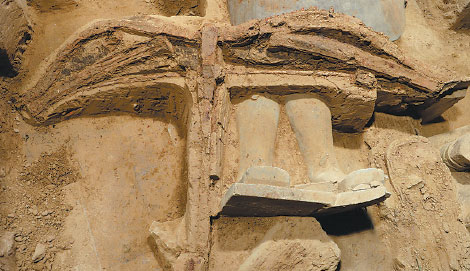
Archaeologists in Shaanxi province have, for the first time, found a complete ancient crossbow, known as a gong nu, that dates from the Warring States Period (475-221 BC).
The weapon was unearthed during excavation work at the No 1 pit of the Qin Terracotta Warriors and Horses collection in Xi'an, the provincial capital.
"We found a number of gong nu in the pit during past excavations, but they were all broken into pieces without qings (a type of protection device)," said Shen Maosheng, excavation team leader and archaeologist at the Emperor Qinshihuang Mausoleum Museum in Xi'an.
"The gong nu we found recently was the only complete one."
Qings were made from ropes and sticks to form a triangular support to protect the crossbows when they were not in use.
"They were used similar to the way we protect our shoes with shoe trees so they can keep their shape when they are not being worn," Shen said.
"The gong nu is a complete one because it had a qing with it. Qings had previously only been mentioned in history books, but now we have a real one, which represents a significant discovery."
Shen said the back of the gong nu is 145 cm long, while the bowstring is 130 cm long and 0.8 cm in diameter. The string might have been made from animal tendons.
The bronze trigger of the gong nu has also been found and will be excavated later, Shen said.
The weapon's arm is made from wood and the shaft from bronze.
Experts said gong nu were used widely in the Warring States Period. Compared with a bow and arrow, the weapon is far more accurate and has a greater range.
Yuan Zhongyi, an archaeologist and former director of the Emperor Qinshihuang Mausoleum Museum, said the shooting range of the most powerful gong nu could be 800 meters, twice that of an AK47 rifle.
Shen said his team started excavation work at the No 1 pit in 2009. It is one of three funerary pits that formed integral parts of the Emperor Qinshihuang's Mausoleum, built in the 3rd century BC and located 1 km away from the pits.
Qinshihuang (259-210 BC), the first emperor of the Qin Dynasty (221-206 BC), defeated six vassal states in the Warring States Period and established a unified country.
The Terracotta Warriors and horses found in his funerary pits in 1974 soon became one of the best-known tourist attractions in the world. They are visited by millions of people every year.
Contact the writers through malie@chinadaily.com.cn
|
Archaeologists have excavated this ancient crossbow, known as a gong nu, at the No 1 pit of the Qin Terracotta Warriors and Horses collection in Xi'an, Shaanxi province. Zhang Tianzhu / for China Daily |