Looking at the future of trade relations
Writing on business in China and India is not easy. Not just because it runs up against a growing and voluminous literature on various aspects of the two countries and their comparative engagements. The challenge is in identifying details and complexities characterizing China and India. These escape observers focused on the big picture, preoccupied with facile questions of when in the foreseeable future will the Indian growth rate match that of the Chinese; or how the "manufacturing" China strategically complements the "services" India.
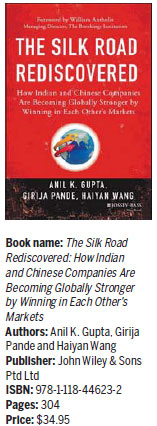
Doing business in China and India is a tale of trials and tribulations, learning ground rules the hard way, and very often, going innovative in processes, practices and strategies for digging gold from dirt. These experiences, enlightening accounts of how businesses adapt and accommodate in the world's largest and most intriguing markets, can be elucidated only by experts familiar with the stories, up and close. The Silk Road Rediscovered by Anil Gupta, Girija Pande and Haiyan Wang, is a good example.
The book is striking in its optimism of the China-India economic relationship projecting it to become one of the world's most significant economic ties in future. It also departs from the conventional approach of judging the relationship by talking "trade" and instead argues the imminence of capital flows and long term investments in driving future bilateral economic engagement. It is in this context that it documents the experiences of Chinese and Indian businesses of working in India and China.
Analyzing the successful growth experiences of various companies such as TCS, NIIT, Tata Motors and Mahindra from India, and Lenovo and Huawei from China, the authors repeatedly emphasize "convergence" - the unwavering theme of the book. "Convergence" posits the hypothesis that in the medium term, China will discard its reputation of being only a manufacturing powerhouse by cultivating expertise in production and export of several modern services; and India, at the same time, would cease being excessively focused on services, as rapid infrastructure growth would expand volumes for manufacturing while making it broad-based. These production transformations and the resultant structural convergence between the two economies, the authors argue, would make the Sino-Indian economic relationship multi-dimensional through a mix of trade, investment, technology, ideas, practices and partnerships.
- China Daily