Innovators for control of Autonomous car market
The battle for supremacy in the driverless car market is revving up.
While companies like Google are investing heavily in the technology, traditional automakers are striving not to be eclipsed
Traditional automakers such as Nissan say they are developing autonomous cars to reduce the number of accidents. A spokesman for Nissan told China Daily that the company's goal is to eliminate fatal accidents.
|
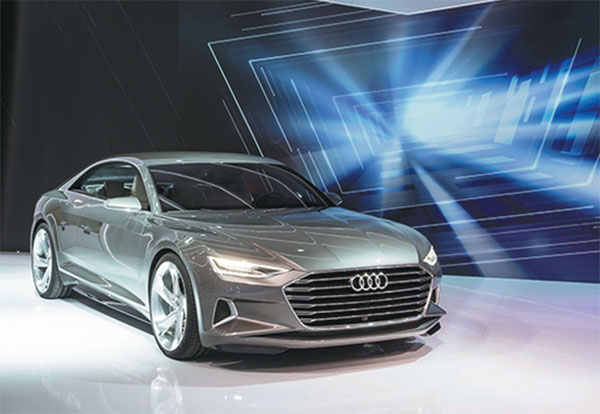
Audi goes driverless with the Prologue Piloted Driving concept. Photo provided to China Daily |
"This goal, together with the zero-emission one, are the two major directions of Nissan's technological routes," he says.
Nissan's self-driving car has sensors and scanners that search for physical barriers, road signs and other potential threats on the road. The data is fed into sophisticated computers which then order the car to speed up, detour or stop.
In July, Nissan president and CEO Carlos Ghosn announced that most of the company's new models will be equipped with a self-parking system. A feature that allows cars to pass through city intersections without driver intervention will be added by the end of the decade.
City intersections are a headache for most driverless technology engineers, as the traffic lights, pedestrians and other vehicles at intersections pose a challenge for self-driving vehicles. It is believed that once this problem is solved, self-driving on other city roads will be a piece a cake.
Companies like Nissan are looking outside the auto industry for partnerships to improve the technology. Earlier this month, Nissan and NASA's Ames Research Center announced a five-year research and development partnership for autonomous driving systems. Nissan won't be the only beneficiary of this cooperation, as NASA will also seek better technologies in future space exploration.
Swedish-origin brand Volvo has a four-step plan for its autonomous driving cars: driver-assistance, partial automation, high automation, and full automation. Hakan Samuelsson, president and CEO of Volvo Car Group, says the company " will be the first to put the high automation driving technologies into mass production", adding that it is gradually applying established technologies to its existing vehicles.
Volvo says autonomous driving technologies are key to its zero-collision and zero-injury goals.
The company's XC90 model can automatically follow the car in its front of it. "It is good news for those exhausted working class people who drive home in traffic jams during rush hour," Samuelsson says.
In 2017, Volvo plans to invite drivers to participate in an autonomous driving test on an ordinary city street in Gothenburg, to see whether driverless cars can blend into people's daily lives. The company says it hopes to achieve complete autonomous driving in 20 years.
"By switching freely from the driver's mode and the autonomous driving mode, people inside the cars can remain energetic and become more efficient," Samuelsson says.
To achieve this goal, two key technologies need to be improved: intelligent auto-safety solutions and connectivity of cars. "With intelligent auto-safety solutions, drivers are less likely to make mistakes; with connectivity of cars, the car can communicate with other cars and the traffic infrastructure, so it can decide the best route to the destination with the minimum amount of congestion," Samuelsson said.
While foreign companies are already setting release dates for their self-driving cars, most Chinese prototypes are still lying in the lab. Major automakers including FAW, Dongfeng, SAIC and Changan have all developed self-driving models and are busy testing them.
To speed up their research and development, Chinese automakers have partnered with various IT companies and universities (Dengfeng with Huawei, GAC with China Academy of Sciences, and FAW with National University of Defense Technology).
"It is the future of cars, and Chinese companies have to pay close attention to their foreign peers," says Li Jinsheng, vice-president of China Association of Automobile Manufacturers. "It won't be easy, but it's an opportunity to reclaim the market in the future."