Time to end the cyber-spying blame game
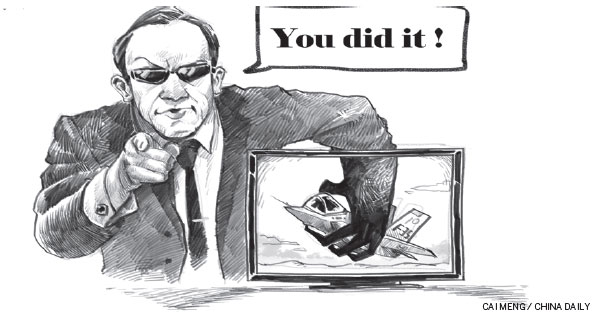
Responding to a report in a German magazine that Chinese cyber spies stole sensitive data on defense programs, such as the United States' F-35 Lightning II fighter jet, China's Foreign Ministry spokesman Hong Lei said on Monday that such allegations are "totally groundless and unproven".
Such baseless accusations are not new for China, which itself has been at the receiving end of cyberattacks. Chinese cyber-spying might have increased the cost of the F-35 Joint Strike Fighter's and delayed its production, said Aviation Week, a New York-based information and services provider specializing in aerospace and intelligence, in 2012.
These allegations are being leveled at China to "prove" that it "stole" data on the US fighter jet to develop its own Chengdu J-20 and Shenyang J-31.
But they seem rather contradictory in the light of the explanation given by Michael Hayden, former director of Central Intelligence Agency, to defend the US after former National Security Agency operative Edward Snowden exposed Washington's surveillance program in 2013. The NSA surveillance program, Hayden said, was designed to collect intelligence to safeguard state security, while China's "cyber-hacking" served as a tool for Beijing to launch unfair economic competitions.
Assuming that China did collect information from cyberspace to improve its fighter jets, how is it not fair? Didn't it help the country to safeguard its national security? At the most, it only shows that China's intelligence organ did a good job, for that is exactly what the US wants the NSA to do for its own national security.
Allegations of cyber espionage, especially by the West, have always been aimed at slandering China - that it has made technological breakthroughs only by plagiarizing Western innovations. This perception remains unchanged since Washington issued the Cox Report in 1999 accusing China of using spies to steal nuclear weapons' technology from the US.
Most governments have intelligence departments whose fundamental function is to collect data from other states and protect their countries from being spied on. According to US national security strategy in the late 1990s, major threats to the country's security intelligence included even Israel, perhaps the closest US ally.
Moreover, countries such as the US should indulge in some introspection before accusing others of stealing sensitive data, because their allegations over the past quarter century, to some extent, show they are rather reluctant to see China's independent yet powerful rise. They need to implement structural reforms, instead of blaming other countries' economic growth, to revive their economies.
China, on its part, has to act more confidently when confronted with accusations of launching cyberattacks; it has to defend its national interests with more nerve. In an article titled "Why we spy on our allies" in The Wall Street Journal in 2000, R. James Woolsey, another former CIA director, addressed the European companies which the US had spied on saying, "we have spied on you because you bribe". No country should adopt such double standards.
As for Beijing, it needs to more vigorously defend its unimpeachable rights and put an end to the futile "finger-pointing" game that it is not at all interested in playing.
The author is an associate professor in the Department of International Politics at Fudan University in Shanghai.