


Power giant embarks on overseas acquisition trail
Huadian Corp charts ambitious plan to be an international player
After making their first overseas clean energy asset acquisition at the end of last year, officials at Huadian Corp, China's largest natural gas-fired electricity provider and a Fortune 500 company, said the organization is firmly on the lookout for other foreign targets.
One of China's five largest state-owned electricity providers with total installed generating capacity of 123 gigawatts at the end of 2014, Huadian bought full control of a 28-mW wind farm in Barchin del Hoyo in Spain from Elecdey Barchin SA.
|
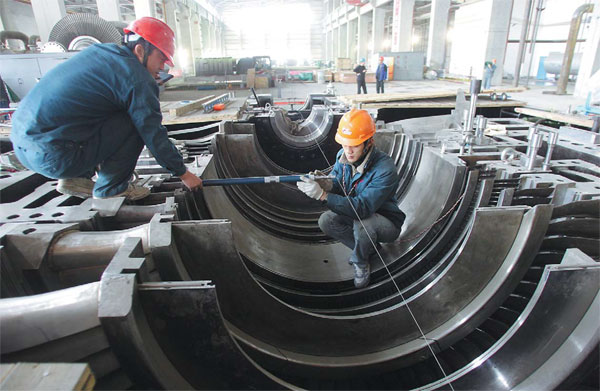
Workers at Huadian Corp assemble generator units. The company is vying to transform its business from being an electricity producer into a comprehensive energy group. Provided to China Daily |
Fu Weixiong, director of its international business department, says that after completing overseas trade contracts worth about 1 billion yuan ($161 million; 136 million euros) in 2014, the group is eyeing opportunities in both renewable energy and conventional oil and natural gas assets, with an overall strategy of transforming the business from being an electricity producer into a comprehensive energy group.
"Europe has been a pioneer in renewable capacity installation, but some companies are facing operational difficulties such as a lack of cash flow or high debts caused by the sluggish economic recovery, and this is creating a window of opportunity for overseas acquisitions," he says.
Fu's target is to grow its foreign holdings fivefold, so that they make up one-tenth of its business by 2020.
Huadian's total assets were worth 720 billion yuan at the end of last year.
The company was ranked 368th in the Fortune 500 in 2013.
Future oil and natural gas acquisitions are a priority for Huadian, the only one of the five state-owned electricity providers so far to invest in a natural gas business, says Fu, adding the company is in discussions with several oil and liquefied natural gas suppliers in North America, although he declined to give details because of confidentiality issues. It also won the country's second shale gas auction in late 2012.
Huadian is China's largest natural gas-fired electricity provider with an installed generating capacity of 7,975 mW at the end of 2014.
The other four state-owned power producers are China Huaneng Group, China Guodian Corp, China Datang Corp and China Power Investment Corp.
Huadian and China Petroleum & Chemical Corp, known as Sinopec, jointly acquired a 15 percent stake in the Canada-based Pacific Northwest liquefied natural gas project in May 2014. Huadian's 5 percent stake secured it an annual 600,000 metric ton supply of LNG, its first overseas source of gas to support its domestic LNG power generation projects.
British Columbia-based PNW's liquefied natural gas is sourced from Progress Energy Canada Ltd's North Montney assets, of which Petronas of Malaysia is the majority owner and project operator. The project is expected to complete two production lines, each delivering 6 million tons of LNG annually by the end of 2018.
Huadian has also won contracts to build a number of coal-fired power plants and hydropower plants in Asia and Central and Eastern Europe, which bring its total overseas power capacity already operating or being built to more than 1,500 mW. The total capacity of its approved projects expected to start construction is around 2,640 mW.
Energy industry analysts said that China's home-grown power technology has vastly improved over the past two decades in terms of sophistication and efficiency, and in environmental sustainability.
As a result, much like its high-speed rail technology, international interest and demand for Chinese-produced energy are growing, helped in no small part by what Chinese energy technology costs compared to others on the international market.
Fu says, for example, that some major power equipment purchased in China could be 30 percent cheaper than in Europe.
The company's first - which is also believed to be China's first power project investment i- in Russia was the $600 million, 483 mW Huadian Teninskaya Gas-Steam Combined Cycling Thermal Power Plant in the Yaroslavl region of Russia, northeast of Moscow, which becomes operational this year.
On the back of that, the group also signed a framework agreement in November witnessed by President Xi Jinping and his Russian counterpart Vladimir Putin to buy the 450 mW Arkhangelsk thermal power station project in the coastal Arkhagelsk region of northern Russia.
"The project is a practical step in Huadian's participation in the national 'One Belt and One Road' strategy as well as being significant to the company's continued overseas expansion," said the group's website.
China launched the New Silk Road Economic Belt and the 21st Century Maritime Silk Road initiatives to further open up China to the rest of the world and to speed up infrastructure connectivity in the regions in 2013.
Analyst expect the strategies to deliver huge opportunities to the country's utility companies, given the expected growing energy needs of many of the countries along the routes.
Huadian has also invested in a 600 mW thermal power plant in Romania, which is expected to start construction this year, and a feasibility study is ongoing to invest in another 700 mW thermal power plant in Serbia.
In Cambodia, Huadian has invested in the Lower Stung Russei Chrum Hydroelectric Project in the country's Koh Kong Province. With a capacity of 338 mW, the plant supplies about one-third of Cambodia's power needs.
Most of the Huadian projects are being financed by lenders like the Import and Export Bank of China and China Development Bank, says Ye Dejie, vice-president of China Huadian Hong Kong Co Ltd, which has been instrumental in handling many of its overseas projects and acquisitions. But the company is also keen to expand its financing channels on the international financial market.
Ye says the corporation always tries to minimize investment risk by selecting potential deals based on two key criteria: economic return and technical feasibility.
Fu says Huadian normally sets higher environmental standards in its overseas projects partly based on the fact that the financial institutions have themselves raised their thresholds, and are unwilling to provide loans to projects that fail to reach international environmental standards.
The banks all adhere to the Equator Principles, the risk management framework adopted by financial institutions, for determining, assessing and managing environmental and social risks of international projects, he says.
lanlan@chinadaily.com.cn
















