Oldest engraving rewrites view of human history
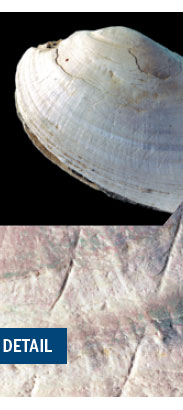
Anthropologists say they have found the earliest engraving in human history on a fossilized mollusk shell about 500,000 years old, unearthed in colonial-era Indonesia.
The zigzag scratching, together with evidence that these shells were used as tools, should prompt a rethink about the mysterious early human called Homo erectus, they said.
The discovery comes from new scrutiny of 166 freshwater mussel shells found at Trinil, on the banks of the Bengawan Solo river in East Java, where one of the most sensational finds in fossil hunting was made.
It was here in 1891 that an adventurous Dutch paleontologist, Eugene Dubois, found "Java man".
With two army sergeants and convict labor to do the digging, Dubois excavated part of a heavy-browed skull, a tooth and a thigh bone.
He interpreted these as being the remains of a gibbonlike hominid that was the long-sought "missing link" between apes and humans.
Dubois' claim aroused fierce controversy, as well as joking images of humans' distant ancestors as slack-jawed primates with dragging knuckles.
Paleontologists eventually categorized the find as a Homo erectus, or "upright human" - a hominid that according to sketchy and hugely debated fossil evidence lived from about 1.9 million years ago to about 150,000 years ago.
Reporting in the science journal Nature, a team led by Josephine Joordens at Leiden University in the Netherlands harnessed 21st-century technology to take a new look at the Trinil shells, now housed in a local collection.
Carbon dating of sediment found in the shells put their age at between 430,000 and 540,000 years. A third of the shells were also found to have a curious hole at the base of one of the bivalve's muscles.
Sharp-toothed animals such as otters, rats or monkeys may have bitten into the shells to get at the flesh, but the experts said that a likelier source is Homo erectus, which tucked into them for food.
The team carried out experiments on living mussels of the same mollusk family, piercing the shell at the same location with a pointed object.
As soon as the shell was broached, the muscle was damaged by the tool tip and the mollusk could be easily opened without breakage.
|
This photo illustration released by the journal Nature shows the fossil Pseudodon shell with the engraving made by Homo erectus at Trinil in Indonesia. AFP |