A tough task to cap emissions by around 2030
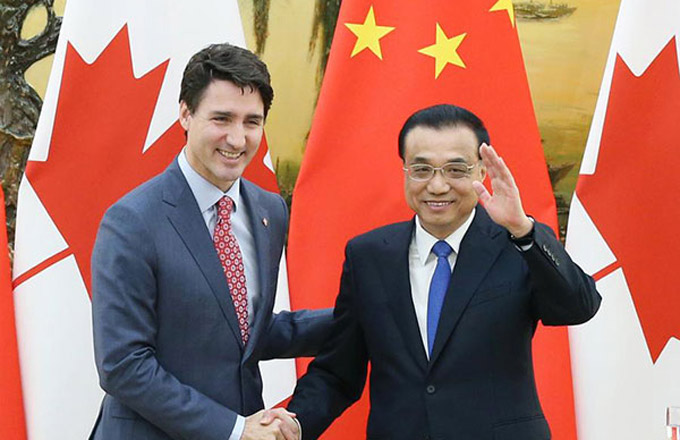
Now that China has signed a landmark deal with the United States setting targets for carbon emissions out to 2030, it should plan the trajectory of its low-carbon path for the next 16 years.
When would China's carbon emissions peak? This question had been troubling journalists over the past years. Even after China, along with the US, has bolstered the global fight against climate change, some environmental activists are arguing that the deal is not good enough. They say China's carbon emissions could peak earlier - because its coal consumption may peak in the next six years - and doubt whether the goal is ambitious enough for a genuine campaign to fight climate change.
Yet many would argue that China's goal in the deal is a daunting challenge.
It is widely believed by experts that China's coal consumption may peak around 2020, and though slight bounces are unavoidable, overall demand is expected to stabilize and then decline after that. In fact, the State Council, China's Cabinet, announced on Nov 19 that the country's coal consumption will be capped around 4.2 billion tons a year by 2020.
That, however, does not mean carbon emissions would peak within the next five years or so, because energy consumption will continue to grow and greenhouse gas emissions from burning other fossil fuels like oil and natural gas will continue to increase.
China's economic and energy structural transition leading to a peak in carbon emissions will take some time given the growing energy consumption to sustain an economic growth of 7-8 percent in the short term. Germany and the United Kingdom took about 20 years to reach their carbon emissions peak after their coal consumption peaked.
Of course, experts expect China to take more green measures to shorten the process of its carbon emissions peak and its energy consumption peak. For this, policymakers have to give full consideration to the targets when devising energy strategies and policies, and the targets should be incorporated into the 13th Five Year Plan (2016-20) under discussion.
He Jiankun, director of the Institute of Low Carbon Economy at Tsinghua University, says China faces a tougher challenge than the developed countries to achieve the target because it is in a different stage of development. Most developed countries had already entered the post-industrial age when their carbon emissions peaked - for instance, the US reached its carbon emission peak in 2005 and Japan in 2007. And most of them maintained an economic growth rate of between 2 and 3 percent when their emissions peaked.
But since China is expected to maintain a grow rate of 4-5 percent around 2030, it has a more daunting task in hand, for it will have to keep its carbon emission per unit of GDP lower than what the developed countries did to reach their emissions peak. Also, since the demand for energy will continue to grow after carbon emissions peak, perhaps a major part of newly added energy has to come from non-fossil fuels for a long time.
He says China needs to increase its wind and solar power capacity by 20 million kilowatts each and nuclear power capacity by 10 million kilowatts a year between 2020 and 2030 to achieve the goal. That would be equivalent to installing ten 5-megawatt wind turbines a day or ten 1-million-kilowatts nuclear power units a year between 2020 and 2030.
It is thus important to evaluate if the existing policies are sufficient enough to achieve the goals and change them, if necessary, says Li Junfeng, director of the National Center for Climate Change Strategy and International Cooperation, a national think tank.
Other experts say more room should be created to allow rapid development of renewable energies, because in the national energy development plan (2014-20) announced on Nov 19, the proportion of coal remains high.
Since it would be unrealistic to leave the resolution of too many issues for the 2020-30 period, action must be taken earlier to shape China's green future and hoist it at the forefront of the global campaign for sustainable development.
The author is a senior writer with China Daily. lanlan@chinadaily.com.cn