Doing a good job of teaching business
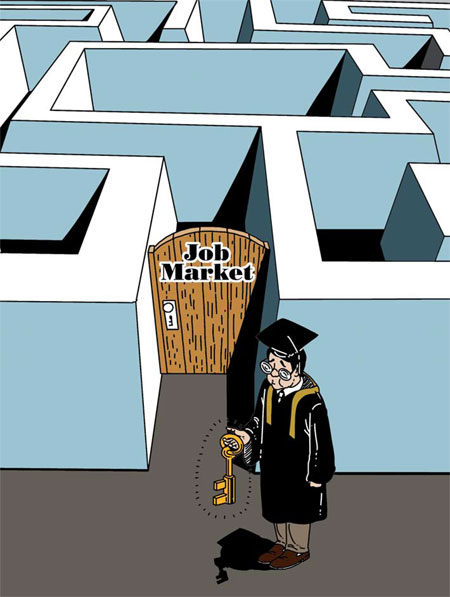
Students should be taught to anticipate scenarios in which to apply their newly acquired business skills
The number of university students, especially in business schools, in China has increased considerably in recent years, giving rise to two important questions: How to ensure that students' time in business schools is well spent, and what approaches to teaching would produce the best results?
The effects of business schools on students should be assessed in terms of their impact on the knowledge, skills and abilities that they apply in their workplaces after passing out of college.
So, what can be done to support the transfer of knowledge from the classroom to the workplace? Extensive studies in human resource management (training transfer literature) have yielded interesting insights that are also relevant to business school education in China, and one of them is that students progress down a learning curve. Initially, they perform new tasks they learn in a self-conscious way.
Over time and with practice, these tasks become automated. Declarative knowledge is turned into proceduralized knowledge. In the later stages of the learning process, students may not be able to consciously recall (declarative) knowledge but can access it (proceduralized knowledge) at a subconscious level.
Moving from the declarative to the proceduralized stage of knowledge representation requires practice beyond, say, delivering a lecture in a seminar and a bit of homework. Of course, one might argue that students rehearse certain meta-skills throughout their college years, such as analytical and critical thinking, researching and applying the results to solve a problem, working in teams and interacting socially, which they are more likely to carry to the longer-lasting proceduralized stage.
The lesson from the training transfer literature, in that context, is that more practice takes students further down the learning curve for a given set of knowledge, skills and abilities.
Another finding of the training transfer literature is that transfer of knowledge is more likely if the knowledge is inculcated in the form of general principles rather than specific procedures. Courses should thus develop a deeper, causal understanding as opposed to providing a step-by-step guide on how to perform a task. As social psychologist Kurt Lewin put it: "There is nothing more practical than good theory."
Having students learn the general principles depicted in management theory requires their cognitive effort in relating the principles to their own experiences, intuitions and cases provided in class. It is this cognitive effort that helps students to internalize knowledge, enabling them to access it whenever required in the future.
Teaching general principles, as opposed to specific procedures, is advantageous in management-related disciplines also because management processes vary considerably across organizations. If students have really understood a generally applicable principle, they will be able to apply it across a wide range of unfamiliar situations at work. The specific procedure, in contrast, is not only less likely to be remembered but also less likely to be applicable in future jobs.
Also, knowledge transfer depends on whether students can recognize situations in which the taught knowledge is applicable when they come across them and whether they will be able to overcome barriers to knowledge application in such situations.
To increase the odds to recognize relevant situations and overcome barriers, students should be taught to anticipate scenarios in which the acquired principles might be applicable.
A vital insight from the training transfer literature is that interactive teaching elements, such as case study discussions, allow students to rehearse the application of knowledge and, thereby, increase the chances of knowledge transfer from classroom to workplace.
The author is assistant professor of human resource management, Nottingham University Business School China, University of Nottingham Ningbo China. The views do not necessarily reflect those China Daily.