Silk Road initiatives are key for China, Europe
Connectivity between Asia and Europe is important for increased cooperation between the two regions. Whether China can promote the continental connectivity depends on how it turns its Silk Road initiatives on the land and sea into tangible projects, said experts who participated in a think-tank symposium in Shanghai.
The forum, held in July, was hosted by the Shanghai Institutes of International Studies (SIIS) and co-sponsored by the European Union, Mongolia, Poland and Singapore. It is within the framework of the Asia-Europe Meeting (ASEM), an exchange mechanism proposed by former Singapore premier Goh Chok Tong in 1994 to bolster cooperation between Asia and the Europe.
Some 60 participants from 28 ASEM members shared their knowledge, experiences and vision while discussing ASEM cooperation on connectivity.
They agreed that ASEM leaders who meet at the 9th ASEM summit in Laos should focus on the importance of strengthening regional connectivity to support economic integration in Asia and Europe. And that it was high time for connectivity to be incorporated as a priority area for Silk Road ASEM.
The ASEM connectivity refers to smoother policy communication, improved road connectivity, unimpeded trade, unrestricted flow of capital for investment and a better understanding between people.
Effective connectivity depends on the quality of what is referred to as hard infrastructure - transport infrastructure, energy pathways, logistics networks, and information and communications technology infrastructure, and soft infrastructure such as policies, strategies, customs procedures, regulatory systems, personnel and institutional capacities building and trans-boundary cooperation.
The diversity of ASEM members, in terms of development levels, historical and cultural background, population densities and national capacities, presents huge potential as well as serious challenges for pushing forward ASEM connectivity.
Most of the forum attendees believe that while members' comparative advantages constitute incentives for cooperation, a sound balance should be reached between national strategies and regional priorities, bearing in mind challenges such as security concerns that may arise at the ground level.
The forum's summary statement to promote cooperation on connectivity includes a regional strategy and a mechanism like a working group within ASEM, taking on board all relevant intra-Asia regional and sub-regional connectivity initiatives.
ASEM members need to form area-specific core groups to cooperate on a voluntary basis. Expanded partnership with regional, international organizations and the private sector is necessary to mobilize sufficient resources.
"It is particularly important to engage industries and businesses, including the small and medium-sized enterprises. The proposed industry dialogue on connectivity is welcome and the idea of creating an ASEM Infrastructure Investment Bank could also be explored," said Yang Jiemin, a senior researcher of diplomacy with SIIS.
The forum's statement suggests to reconvene the ASEM Economic Ministers' Meeting as soon as possible, and to hold a Transportation Ministers' Meeting on a regular basis to build consensus, enhance coordination and identify eligible areas for cooperation.
ASEM connectivity may only be possible with real and practical action. Initiatives such as the Master Plan on ASEAN Connectivity, Silk Road Economic Belt and 21st Century Maritime Silk Road all need efficient coordination to translate words into deeds.
"China should play a more active role in providing initial fund support, technology assistance and personnel to improve the transportation infrastructure on the continent. China's sustainable economic growth laid a solid foundation for China's dedication to the initiatives of Silk Road," said Zhao Gancheng, a researcher with SIIS.
There were also different voices heard at the forum.
Stephen Roach, a Yale economist and former chief economist with Morgan Stanley, points out the authority should focus not just on the integration of the tradable-goods economy, which is something that goes back historically, but also increasing the integration of the services economy through IT- enabled connectivity.
"I think those are the areas that have led leaders to focus on and then lapse into sloganeering on silk roads and other types of high profile demonstration projects. Those are part of the process, but they are not the essence of what needs to be done in China," said Roach.
in Shanghai
|
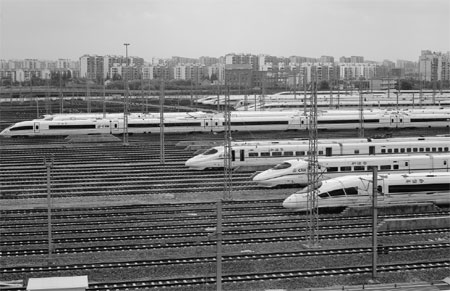
High-speed railways in Shanghai. Reliable high-speed railway is one of the projects that China promotes around the world. Gao Erqiang / China Daily |