Mountain's fruit and fungus a local lifeline
Wild plants and edible fungus grown in the Greater Hinggan Mountains in Northeast China's Heilongjiang province provide locals with their livelihoods.
Thanks to the wild resources, farmers or forest workers earn at least 1,200 yuan ($195) per month, 334 yuan higher than the average income of residents in Heilongjiang province, bordering Russia to the north.
"The Greater Hinggan Mountains are home to wild blueberries in China," Heilongjiang Daily reported.
|
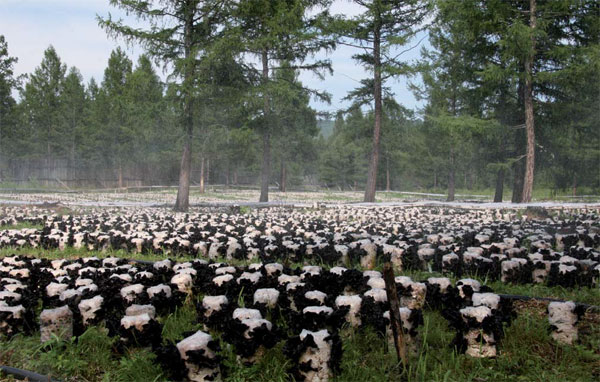
Edible fungus in the Greater Hinggan Mountain area. More than 30 million yuan has been invested in black fungus cultivation and processing bases in Tahe, one of the key projects of Heilongjiang province. Photos provided to China Daily |
Ninety percent of the wild blueberries in China and 30 percent worldwide are from the Greater Hinggan Mountains. In August, tens of thousands of locals go into the mountains and pick blueberries, plums and red beans, which earn each of them more than 1,000 yuan a day.
There are about 30 blueberry processing companies in the region that make about 140 types of products including drinks, jam and dried blueberries.
Local residents also make money from the medicinal plants grown in the mountainous area. About 300 kinds of medicinal herbs including codonopsis pilosula, astragalus membranaceus, lucid ganoderma and Chinese herbaceous peony can be found in the mountains.
The local government has developed medicinal markets in Bozhou, in Anhui province in Central China, and Anguo, in Hebei province in North China, for its people. Bozhou and Anguo are among the world's biggest business centers for Chinese herbal medicine.
Residents around the Greater Hinggan Mountains became more dependent on wild plants and edible fungus instead of timber after the Wildwood Protection Project was launched in 1998, when floods killed 3,704 people and caused economic losses of $26 billion.
The Greater Hinggan Mountains, which extend 1,200 kilometers across Heilongjiang province and Inner Mongolia autonomous region, also boast edible fungus.
Sixty-nine normalized black fungus bases, covering 22,000 mu, about 1,467 hectares, and 306 greenhouses where black fungus grows in bags, were built in Xinlin district, Huzhong district, and Tahe town in Heilongjiang in 2013.
More than 30 million yuan has been invested in black fungus cultivation and processing bases in Tahe, one of the key projects of Heilongjiang province.
songmengxing@chinadaily.com.cn