South America is prime market for Chinese automakers
 |
|
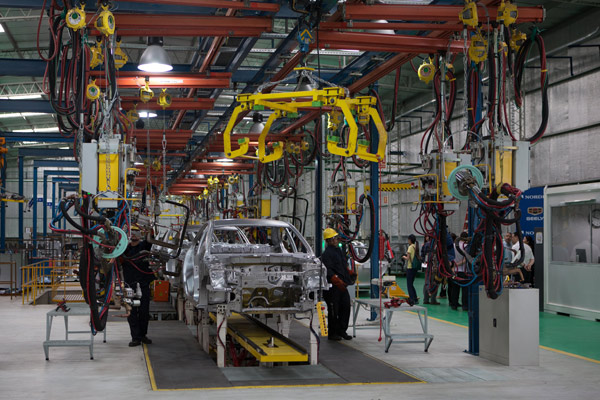
Chery's Uruguayan plant. Provided to China Daily |
Arturo Peralta Vierci, an auto dealer in Paraguay for Chinese brands Foton and Geely, says he is selling more and more of them.
"Chinese brands are getting a better and better reception in Paraguay and neighboring countries where I have customers," Vierci said. "I think this trend will go on for a long time."
South America has become the largest export destination for Chinese automakers, according to the China Association of Automobile Manufacturers. Last year, China exported 286,500 vehicles to the region, up 19 percent over the previous year, and 30 percent of the total number of vehicles exported, the association said.
For the past five years, the emerging markets have been driving the growth of China's auto sector, industry veteran said.
Previously, trade companies were the main handlers of overseas demands, but the landscape is changing.
Major Chinese brands such as Cherry, Geely, JAC and Great Wall have all started, or will soon start local manufacturing to skip the tariff and logistics cost.
Three years ago, Geely signed an agreement with Nordic, a major local auto parts assembler, to build a plant in Uruguay. Last August the first car rolled off the assembly line. Nordic was established 50 years ago in Uruguay and was once the assembler for Renault, Citroen and Peugeot.
The country borders Brazil and Argentina and has agreements with multiple South American countries to import and export manufacturing products with tax rebates. Cars produced in the new plant will mainly be sold to Brazil and Argentina, Geely said.
Another well-known Chinese brand, Chery, went even further in South America. Its first factory in Venezuela opened in 2011, and another one in Brazil will soon start operating in July. The car produced in the plant will be a revised version of its compact model Fowling, and the engine is designed as gas/ethanol double fuel.
The initial investment is $140 million and the plant will have a manufacturing capacity of 50,000 units. Chery Brazil CEO Luis Curi said the company can deliver 30,000 cars in Brazil this year.
Based on Chery's blueprint, the company will sell 650,000 cars in 2016, with the Brazilian market expected to contribute 11 percent of the sales.
JAC recently announced that its Brazilian assembly plant will start up in 2015, with annual production of 100,000 cars.
Lifan Motors also established a local plant in Uruguay in 2010.
China automobile association statistics show that among the 51 auto brands in the Brazilian market, 12 are Chinese; among the 54 auto brands in Uruguay, 26 are Chinese. Last year, Chinese brands took 23 percent of the market in Uruguay.
Shi Jianhua, deputy secretary-general from the China automobile association, said Uruguay has become an ideal place for Chinese automakers to test the waters in South America.
"Compared with Brazil, labor relations and the taxation system are simpler, and the foreign currency control is much looser, so many companies use this country as a springboard to Brazil," he said.
But the company with the best margins — Great Wall Motors — is acting mush less aggressively than its Chinese counter parts. Great Wall is known for its cautious style and claims its top strategy in overseas expansion is "steady".
The company started exporting as early as 1998 and shipped 73,000 vehicles overseas last year, among the top three exporters.
According to initial plans, the company was going to open a plant in Brazil at the beginning of last year, but so far the $1billion project has been postponed to this year.
The three models planned for this plant include a pick-up and two SUV models.
In 2012, China exported more than 1 million vehicles, but the following year the number dropped.
Dong Haiyang, president of BAIC International, said that should serve as a warning to overly optimistic Chinese automakers.
"Demand in overseas market doesn't necessarily mean we can sell cars easily. We should build a value chain in these markets including spare-parts procurement, manufacturing and even auto financing," he said.
"We should drop the imagination that a single Chinese product can suit the global market. We have to adapt to the local needs," Dong said. "Previously, we only had trade companies, which are incapable of carrying out this mission, but now that we have our own local plants and research centers, we can respond to the market much quicker."
wangchao@chinadaily.com.cn