Tea gone wild
The cultivation of pu'er has brought sudden wealth to tea growers in Yunnan, especially those with wild trees that are centuries old. Guo Anfei in Kunming and Fan Zhen in Beijing sip the celebrated brew and report.
With spring coming to an end, Iceland has again become a hot word in the tea industry. Not because of the Nordic island in Europe, but because of the skyrocketing prices of wild tea leaves grown in the homonymic village in China's southern Yunnan province.
At the first Shuangjiang Mengku (Iceland) Tea Fair held in April, the premium spring Iceland tea from Shuangjiang Mengku Tea Co fetched 120,000 yuan ($19,500) per kilogram at auction, beating its 100,000-yuan record in 2012. The remaining five companies commanded a little over 20,000 yuan per kg for their teas.
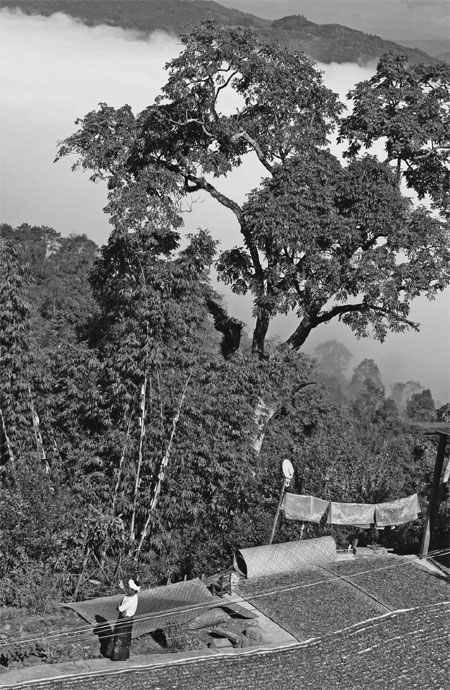
The price hike has brought certain prosperity, and a bit of risk, to the small village that sits isolated 2,000 meters above sea level along the once-bustling Ancient Tea-Horse Road.
"Tea provides our main income," Luo Wenjiang, a local tea farmer, says. "The price of the wild one didn't go up until 2007, and it was always a mild increase before last year."
His family has more than 400 wild tea trees, including 14 that are around 500 years old. The sudden markup has greatly improved his life. With 200,000 yuan in annual income, he has already built a new house and bought a new car.
Another villager, A Wang, says he started four years ago to rent out his 10 ancient trees for only 10,000 yuan each year. The wild tea was only worth 80 yuan per kg back then.
"I didn't expect the price would shoot up so high," he says. "I can't wait until the lease ends in October so that I can take my trees back."
He also owns a 0.4-hectare parcel of land with industrial tea. The cultivated tea trees, trimmed waist-high, provide 20,000 yuan annually.
"That doesn't compare to what a single ancient tea tree can earn me," he says.
The rolling hills where these two families have resided for generations are the birthplace of tea and are the origin of the southern Ancient Tea-Horse Road, a business bond that connected Yunnan's tea to the rest of China and the world beyond.
More than 180,000 aged trees, including 500 trees more than 500 years old, are still scattered in that region. The tea that is made from their leaves is called pu'er.
Pu'er is no new name for tea lovers. Some promoters call the aromatic beverage a wonder tonic that reduces cholesterol and lowers blood pressure. Some see it as the "soft gold". And some compare it to Western wine-the older the better.
The excitement for pu'er tea from Yunnan from 1999 to 2007 drove the prices up tenfold, to a tipping point of 17,000 yuan a kg for the finest aged pu'er, before collapsing far below its pre-boom levels.
Even before the boom and its aftermath, the urban sipping class narrowed its attention to the wild pu'er tea from trees at least 300 years old.
"The tea from the ancient trees has a mellow aftertaste. Rare and nutrient-rich, it is difficult to obtain from the tall, gnarled trees in the mountains," says Dong Zi, president of Kunming Gu Cha Fang Tea Industry Co. "And it's completely pesticide-free."
"People say you can get drunk from drinking (industrial) tea, but insiders know that you are actually 'drunk' from consuming too much pesticide residue," says Tong Xiaofeng, who has sold wild tea from Yunnan for almost five years in Beijing. "That's why some customers began to seek something natural."
There are three major wild-tea production areas in Yunnan: Xishuangbannan, Pu'er and Lincang. The famous brands' average prices per kg range from Iceland's 20,000 yuan, and Banzhang's 8,000 yuan to Jingmai's 1,500 yuan.
"Unlike green tea, pu'er tea has no shelf life. That's why some nouveaux riches try to save the tea and corner the market," says Dong, noting that the price of wild tea has almost overtaken that of the 2007 bubble.
Some professionals, meanwhile, urge the crowd not to blindly follow the trend.
"Ancient tea trees need to be protected instead of exploited," says Yang Chongren, a researcher at Kunming Institute of Botany under the Chinese Academy of Sciences.
"Some of them are on the verge of extinction. We should make relevant protection laws and regulations before it's too late."
Yu Xiang, president of Kunming Junxianghao Tea Co, warns that more than 98 percent of "Iceland tea" in circulation is fake: "The village only produces 8 tons of tea every year but there are more than 300 tons in the market."
Tong Xiaofeng also admits it's hard to clarify the standards of real wild tea, although he takes a sip almost every day.
"It's all in the taste," he says. "But just like a jeweler, you really have to be experienced to spot the true treasure."
Contact the writers through fanzhen@chinadaily.com.cn.
|
A tea farmer dries the newly harvested tea leaves from wild tea trees in Yunnan province. Photos by Zhang Jing / For China Daily |