Vet sheds light on Japan's war crimes
98-year-old bears witness to atrocities on 'Railway of Death'
It is important to share the true story of what happened during World War II against German and Japanese fascism, according to a 98-year-old veteran.
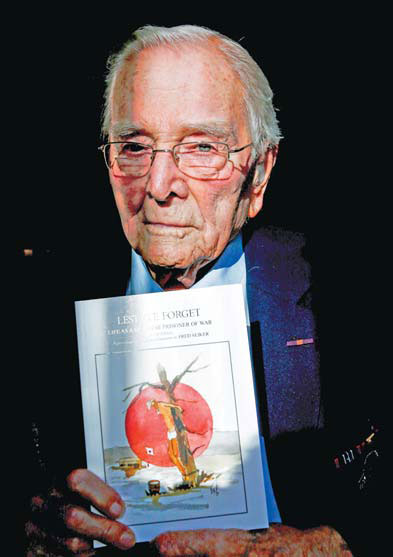
Fred Seiker, a Dutch war veteran who lives in Worcester, England, told China Daily: "I wanted to show people what really happened during that dreadful period, particularly the younger generation. If I could alert them to the dangers of appeasement at all cost, then perhaps a repeat of such a horrendous crime can be averted."
Seiker, who survived action in the North Atlantic and on the Thai-Burma Railway, wrote a book about his experiences.
Lest We Forget, available in English and Chinese, was first published in 1995 and is now in its fourth edition.
The veteran's book details the horrors he saw as a Japanese prisoner of war, including prisoners worked to death.
Worked to death
Many of those deaths occurred during the construction of the notorious 415-kilometer-long line between Bangkok and Rangoon, Burma (now Yangon, Myanmar).
Built in 1943 to carry Japanese forces, it was closed in 1947, though one section was reopened in 1957.
About 180,000 Asian civilian laborers and 60,000 Allied prisoners of war worked on the railway. Of those, an estimated 90,000 Asian civilians and 12,399 POWs died as a result of the project.
"I felt that whatever I had to say in the book had to be honest and defendable," Seiker said.
"When I set out to write it, I thought it should inform the public at large about what happened - in particular, during the construction of the Thai-Burma Railway because very little was known about it at the time."
Born in the Netherlands in 1915, Seiker completed his primary and secondary education in Rotterdam, and attended the Rotterdam College of Marine Engineering.
He served in the Dutch Merchant Navy before and during the war. In peacetime he mainly served on ships plying the Far East, South Africa, Canada and the Eastern Seaboard of the United States.
During the war he served on North Atlantic routes and between Asia and the United Kingdom.
In 1942, Seiker was caught up in the Japanese invasion of Java. Unable to leave the island, he volunteered to serve with the Dutch armed forces and subsequently became a POW of the Japanese.
He was shipped out to Changi prison in Singapore, from where he was sent to Thailand to work as a slave laborer on the infamous "Railroad of Death".
"I looked at myself in the mirror many times and said to myself, "What did I do? How lucky I have been?" Seiker said.
"Considering the chances I had taken in the convoys and the chances I did not take, it was not my doing that I came out of there alive, believe me. It was a miracle."
This January, Seiker read an article in The Daily Telegraph by China's ambassador to the United Kingdom, Liu Xiaoming, about Japan's refusal to face up to its aggressive past.
It prompted him to write to the ambassador.
Seiker told Liu the letter was "a small token of support for your article in the name of my friends who were murdered by the Japanese military whilst working on the Thai-Burma Railway".
Liu's article, published on Jan 2, criticized Prime Minister Shinzo Abe for visiting the Yasukuni Shrine, where 14 Class-A war criminals are honored, last December. Liu accused Abe of deliberately raising tensions in Asia and putting the world on a "perilous path".
Abe has also openly questioned whether Japan was an aggressor in the war. Critics see this as an attempt to airbrush Japan's aggressive past and colonial rule.
"When the war finished, they (Japan) signed an agreement that they would never start a war again," Seiker said.
"Since then, over many years, they have changed the lessons in schools and colleges, making out that all the bad things they did didn't happen, so the students don't have a clue what their grandparents did to us," Seiker said. "And now they want to remilitarize."
'Heart-rending'
Liu read Seiker's letter and book, which he said he found heart-rending.
In a reply, Liu wrote: "People have a right to know what happened in that tragic past and should not forget what horrendous crimes Japanese militarists are capable of.
"To forestall the resurrection of militarism, there is a compelling need to record history as it is, and truly learn the lessons."
Seiker noted that the Chinese edition of his book was translated by Dr Bee Sun Lu of Houston, Texas, who is a fiery opponent of Abe's policies. Her father was executed by Japanese military police along with all the staff of the Chinese embassy in Manila.
Although World War II ended on Aug 15, 1945, the Dutch prisoners of war were not repatriated until May 1946. That year, Seiker arrived in England and began a career in engineering.
After retiring in 1985, Seiker and his wife moved to Worcester, in the English Midlands, where he took up painting as a hobby. He is now an accomplished watercolor artist.
During the 50th anniversary commemorations of Victory over Japan in August 1995, Seiker held an exhibition in Worcester, titled "Lest We Forget". His watercolors, based on memory, represented either personal experiences or events he had witnessed as a POW.
"I had for many years harbored a quiet anger at how the Burma and Thai railway theater of war was almost deliberately ignored by various governments," he said.
"I am deeply moved by Fred Seiker's story and also salute his outstanding fortitude and exceptional humanitarianism," said Zhang Kexin, 22, a Chinese student who studies in the United Kingdom.
Jin Chen, who works in Beijing, said he is looking forward to reading Seiker's book and paying his huge respect to the veteran.
As next year marks the 70th anniversary of victory in the war against fascism, Seiker said he is often asked "by well-meaning people whether I can forgive or forget."
The question of forgiving, he said, "is perhaps one of religious belief or conscience, but to forget is a dangerous road to tread. Nothing that life throws at a survivor of the Thai-Burma railroad can ever be as daunting as the building of the 'Railway of Death'. Forget? Never."
Zhou Heran contributed to this story.
zhangchunyan@chinadaily.com.cn
|
Fred Seiker shows his book, Lest We Forget, which tells about his experiences during World War II at his home in Worcester, England. Yin Gang / Xinhua |