


Housing prices to diverge
Home prices in China will experience greater regional divergence in 2014, with an increasing risk of price declines in smaller cities, industry experts said.
"It's a time of further divergence in China's real estate sector, whether in cities, enterprises or products," said Gu Yunchang, deputy head of the China Real Estate and Housing Research Association.
Marked regional divergences intensified in 2013 as prices rose, which was very different from the housing boom in 2009-2010.
|
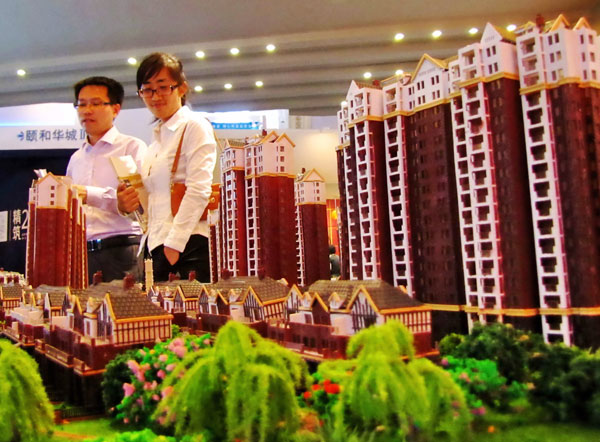
Residential property models are displayed at an expo in Shanghai. In first-tier and some second-tier cities, more tightening policies may be imposed in 2014, experts say. Provided to China Daily |
Prices in first-tier cities rose much faster than elsewhere last year, driven up by a lack of supply and tougher curbs. In November, new home prices surged more than 20 percent in Beijing, Shanghai, Shenzhen and Guangzhou, according to the National Bureau of Statistics.
New supply increased much faster in smaller cities, with only moderate price rises.
Prices in third-tier cities (those below the provincial capital level) increased by 4 percent in November, "and housing affordability remains at an acceptable level", said Zhu Haibin, China economist at JPMorgan.
Given the price divergences, real estate policies will also differ, according to Huang Yu, deputy head of the China Index Academy.
In first-tier cities such as Beijing and Shanghai, and some second-tier cities, more tightening policies may be imposed in 2014. But in some third-tier cities, where supply is sufficient, policies may even be eased to stimulate demand, said Huang.
Economists and industry experts said home prices will rise again this year, although at a slower pace, with widening regional divergences.
"We expect house prices to increase 10 percent in first-tier cities and by 5 to 10 percent in second-tier cities. Prices in third-tier cities will remain flat in 2014," said Zhu.
Tighter credit will help contain price rises, but demand-supply conditions will remain the main driver.
"Although housing bubbles are more noticeable in first-tier cities, the shortage of supply implies that it takes time for markets to correct. In some smaller cities with more abundant supply, house prices may start to decline in 2014," Zhu added.
China Vanke Co Ltd Vice-President Mao Daqing expressed a similar view. Although first-tier cities experienced a strong price rebound in 2013, the risks of fluctuations in those cities remain controllable, compared with those in small towns.
The forecast is based on the assumption that housing policies will not change significantly in 2014.
In recent months, first-tier and some second-tier cities where housing prices have risen faster introduced new tightening measures.
These policies mainly focus on tightening purchase restrictions and imposing tougher mortgage conditions, such as increasing the down payment requirement from 60 percent to 70 percent for mortgages on second residences.
These measures have been in place for several years, and the marginal impact has been limited, said Zhu.
"In addition, supply-side measures seem to lag. It is unlikely that a real estate tax will be expanded nationwide in 2014, and the ambitious affordable housing plan has had little impact on the private housing market," said Zhu.
In the long term, even if a correction starts for housing prices, it is unlikely to lead to a housing crisis or even a financial crisis as in many other countries, Zhu stressed.
"This is because housing bubbles in China are mainly in first-tier cities, which represent only a small portion of the national market," said Zhu.
In 2012, the four first-tier cities - Beijing, Shanghai, Shenzhen and Guangzhou - only accounted for only 4.7 percent of the total population and 3.8 percent of home transactions, according to JPMorgan.
"In contrast, housing in other cities is still affordable in general. Hence, the housing market at a national level is more likely to return to a normal cycle rather than fall into a collapse scenario as markets have feared," said Zhu.
According to the China Index Academy, sales in terms of floor space will rise 5.5 to 7.8 percent throughout the year, compared with 73.8 percent in first-tier cities just so far this year.
huyuanyuan@chinadaily.com.cn
















