History etched in stone
 |
|
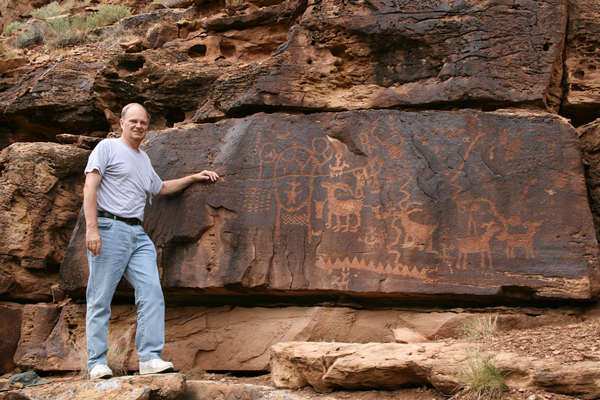
When hiking in Utah with his family, John Ruskamp was captivated by a drawing on a rock with a heavy patina of age. Photo Provided to China Daily |
An enthusiastic amateur believes ancient Chinese script he's found among Native American pictographs prove that Asians crossed the Pacific centuries ago, he tells Mike Peters.
Did migrating Asians settle in the Americas centuries ago?
It's not a new idea, but the theory has a new champion: a mild-mannered retiree named John Ruskamp.
And unlike some of his predecessors - many of whom he cheerfully acknowledges were "crackpots" - Ruskamp believes he's got the long-sought proof.
Writing.
"Multiple groups of North American petroglyphs make the strongest argument," says Ruskamp, who has trekked thousands of miles in the American West to examine and document rock art there.
"They are readable groups of ancient pictograms, Bronze Era Chinese script in most cases. The display of individual and dispersed Chinese pictograms, often integrated into native rock art across North America, demonstrates that these symbols were widely understood as writing."
That's significant for a secondary reason, he says: "Native Americans are not credited as having used writing."
Ruskamp wades into a long-raging controversy bearing four college degrees and a career in each field - biochemistry, education, finance and business. His resume may not impress doubters, and there are many.
"For a long time, there have been wild and unsubstantiated claims for an early Asiatic presence in the Americas. Such non-science unfortunately places a cloud over any new serious research on this topic, so much so that it is often assigned to the 'lunatic fringe' with UFOs and the like," he says.
Ruskamp had been in Asia a few times back in the 1970s.
"I didn't learn the languages, but I grasped the pictorial basis of writing," he says. He followed up that interest with some online courses after he retired years later, and then while hiking in Utah with his family, he was captivated by a drawing on a rock with a heavy patina of age.
"Wait a minute," he recalls thinking, "I've seen that before."
"That", he was convinced, was zhou, the Chinese symbol for a boat.
"The challenge was: Could I find more?" Ruskamp says. "I did - distinctive images of fruit trees and animals, for example - hundreds of them." Such Bronze-era Chinese script definitely dates between 1200 and 200 BC, and "between 900 to 500 BC is the best guess", he says.