Abe's shrine visit unwise, scholars say
|
Chinese scholar Jia Qingguo (left), speaks at a panel on Wednesday in New York while Japanese scholar Yoshihid listens. Zhang Yang / for China Daily |
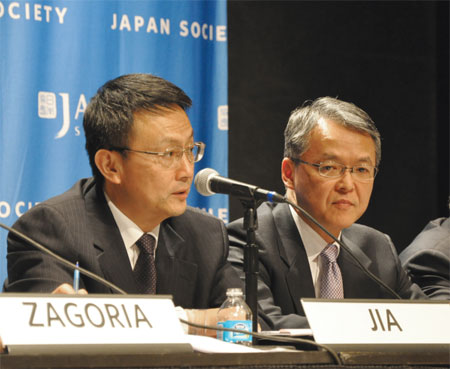
As the after-effect of Japanese Prime Minister Shinzo Abe's controversial visit to the Yasukuni Shrine ripples on, scholars from the United States, China and Japan called the visit a reckless move for Japan.
"Abe's visit to Yasukuni did not serve Japan's national interest and it led all kinds of critical commentaries in the press in the US, in Europe and elsewhere," Gerald Curtis, Burgess professor of political science at Columbia University, said during a panel discussion at Japan Society in Manhattan on Wednesday.
In the panel, titled The US-Japan-China Triangle: Building a Path to Trilateral Cooperation, Curtis also emphasized that the wording used by the US government's statement regarding the shrine visit was very "tough" to use against its ally.
The US Embassy in Tokyo on Dec 26 stated that "the United States is disappointed that Japan's leadership has taken an action that will exacerbate tensions with Japan's neighbors."
"Prime Minister Abe has said that Yasukuni is the same as a cemetery. It's not the same as a cemetery. The point is that it is not politically neutral," said Curtis. "If the Prime Minister visits Yasukuni, it does convey that he was making a political message in support of the Shrine's interpretation of history."
A monument in the Shrine is dedicated to the Indian Justice Radha Binod Pal, the only judge at the Tokyo War Crimes Trial that voted to acquit all the defendants, Curtis said.
Yoshihide Soeya, a Japan scholar at the Woodrow Wilson International Center for Scholars and director at the Institute of East Asian Studies, said that for years Japanese prime ministers have been avoiding visiting the shrine to prevent potential conflicts.
"To me (Japanese prime ministers) not visiting Yasukuni is the norm. In that sense, Abe is an exception," Soeya said. "And I don't believe any prime minister after Abe would do the same."
Jia Qingguo, professor and associate dean of the School of International Studies of Peking University, said it is "understandable" that as a national leader Abe feels "it's an obligation to honor those who died" for his country. "However, Yasukuni Shrine is a place where war criminals are housed as well," Jia said. "If he wishes to stand up against China, he has chosen the wrong issue."
To alleviate the current tension between China and Japan, Alan Romberg, panelist and director of the East Asia program at the Washington-based Henry L. Stimson Center, suggested that Abe make a clear stance on not visiting the shrine in future.
"It will be helpful if Abe clearly signals (that) he will not visit the Yasukuni Shrine again as a prime minister, and if he personally and directly affirms his adherence to the Murayama and Kono statements regarding Japan's culpability to the past degradations," Romberg said.
The panelists also discussed the Diaoyu Islands dispute and called for both countries to compromise.
"The formula for a deal is very clear. You have to put this issue back on the shelf," said Curtis, saying the dispute can't be resolved in the short run.
"But first the Japanese have to recognize there is a dispute. There's no question in my mind that it has to happen. But there has to be a way of doing it without saying that 'we recognize it that there is a dispute'," Curtis said.
Zhang Yang contributed to this story and can be reached at yangzhang@chinadailyusa.com
(China Daily USA?01/24/2014 page2)