Brazilian food offers a taste to savor
With a little more salt than usual, good barbeque still appeals to all
 |
|
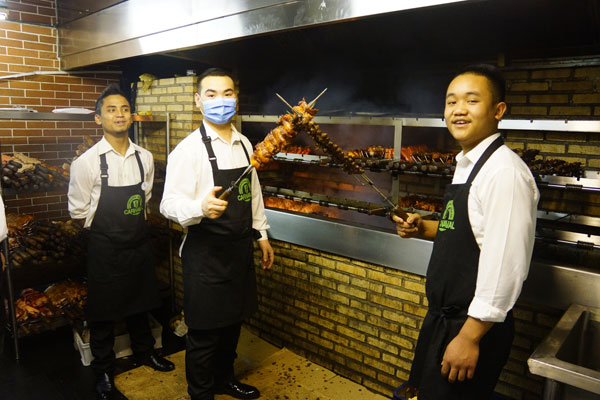
Chefs at Brazilian style restaurant Carnaval shows churrascos meats, the most popular being ox rump and hump and loin of lamb, with squid available too. Ye Jun / China Daily |
Churrascos, or Brazilian barbeque, are setting taste buds aflame as Brazilian-style restaurants offer plenty of food for thought, not just about the cuisine but also about the country.
For the past 10 years, Humberto Francelino Monteiro, 49, has acted as chef de cuisine for Brazilian Churrascos, a 96-seat restaurant in V-Continent Beijing Parkview Wuzhou Hotel, a five-star hotel at the Asian Games Village.
“When Chinese people see something different, they like to come in and try. That, and the food on offer, is what makes it popular in China,” the chef said.
Chinese people like roast meat and barbeque, according to Wang Xiaomeng, general manager of Carnaval, a Brazilian-style restaurant with five chains in the capital.
“The concept of a good barbeque appeals to young Chinese people,” Wang said. “It is a free form of eating. As you can see, similar eateries offering Korean barbeque and Xinjiang skewers are also popular.”
Both restaurants offer an array of dishes in a buffet including salad, meats and often some signature Brazilian dishes such as black beans with pork to go with steamed rice.
As diners tuck in at their tables, waiters serve barbequed meat.
Wang Xiaomeng’s Carnaval restaurant has adopted a rain forest setting and has a precious ornamental stone slab, imported from Brazil. The restaurant puts on a South American dance and music show every night, except Monday. After 30-40 minutes, they invite diners to participate in a Latin dance.
Both restaurants will rebroadcast World Cup matches in the summer with no need to guess who their favorite team will be. Monteiro says churrascos are done in a Brazilian style but adapted to local tastes.
“We use a little more salt than Chinese people,” he said so he reduces the amount.
The chef’s churrascos offer 23 barbequed meats and seafood. The most popular choices are ox rump, ox hump and lamb loin. Aside from beef and pork, chicken, lamb, and a special squid with tomato and chili sauce are on offer.
Carnaval Restaurant offers only three to five Brazilian dishes, including stewed pork with black beans, apart from 15 barbequed meats. Most other dishes are cooked Chinese.
Monteiro opened Brazilian Churrascos 10 years ago but he came to China 14 years ago to work in a Brazilian-style restaurant in Shanghai. He has seen them grow in popularity.
“I can find at least seven in Shanghai and I know of three in Shenzhen. There are some really good brands developing in the country,” said the Brazilian chef from the city of Fortaleza in the State of Ceara.
Wang Xiaomeng estimates there are more than 10 Brazilian buffet and barbeque-style restaurants in Beijing.
Alameda, a South American-style restaurant in Beijing’s Sanlitun bar area is popular among both Chinese and expat customers.
“Football, carnival and churrascos—these reflect Chinese people’s deepest impression of Brazil,” said Wang Xiaomeng.
“Brazilian style restaurants open and close in China. The ones who can survive are those that offer good value for money,” said Wang. Carnaval Restaurant’s set meal costs 88 yuan ($15) per head.
He said his restaurant is designed as a place for people to experience Brazilian culture.
“Brazilian churrascos will help Chinese people learn more about Brazil,” said the Beijinger.