Beijing leads world in climate change response, UN says
China leads the world in improving climate thanks to a tradition of "long-term thinking and planning", the United Nations' top climate official said.
"It's not just the political system (causing the progress), it's the capacity to think and plan into the long term," Christiana Figueres, executive secretary of the UN Framework Convention on Climate Change, told an audience on Tuesday at the Americas Society/Council of the Americas in Manhattan.
With hopes of a global climate agreement facing a critical two years leading up to what is expected to be the decisive meeting in Paris in December 2015, China is battling severe smog problems stemming from its world-leading coal dependency that chokes thousands and forces them to wear face masks, Figueres said. "There is public pressure to move toward cleaner energy sources," she said. "People in China would actually like to breathe air they don't have to look at."
China also wants to be competitive, "not just now, but 50 years down the line", Figueres said. "And what will be competitive 50 years down the line? Low carbon products and services, because that's the direction of the movement."
Last month, China opened a carbon dioxide emissions market covering seven cities to slow rapid growth of heat-trapping emissions. It also has set policies for improving energy efficiency and developing low-emissions power from nuclear and renewable sources.
Figueres said China's standards for buildings and transportation and its support for photovoltaic technology have helped cut solar-panel costs 80 percent since 2008. "They're number one in solar," she said. "They're investing in the future" because they realize that doing so will pay off in the long term, she said.
Although China's centralized leadership system helps it avoid legislative hurdles seen in the US and other countries, the nation's urge to combat global warming stems from a tradition of long-term thinking that is more prominent there than in the West, Figueres said.
"This short term-ism that is so chronic in our society that is reinforced by electoral cycles is not something China participates in," Figueres said. "There is much more long term planning. And that in this respect for climate is a huge advantage. It's not just the political system, it's the capacity to think and plan into the long term."
Negotiators remain deadlocked over numerous issues that have stymied efforts to craft a comprehensive global climate-change strategy.
The climate body's member nations agreed in 2010 to hold the increase in global temperatures to 2 degrees Celsius, or 3.6 degrees Fahrenheit, above preindustrial levels to avoid the most serious consequences of climate change. At a Warsaw meeting in November, little tangible progress was made on reducing global greenhouse gas emissions to achieve that goal.
Lima, Peru will be the setting for the next UN climate change meeting, in December.
Figueres has said the need for international regulation to tackle the threat of climate change is "much more compelling" now than at the failed talks in Copenhagen in 2009 because of the mounting evidence of the effects of global warming. She has said she expects a draft agreement of less than 50 pages, including a goal of zero net greenhouse gas emissions by the second half of the century, to be ready for discussion at the Lima climate talks at the end of the year.
She was quoted in the Financial Times as saying it would be a "tall order" to transform the world's energy system to reach that goal, but said she expected advances in technology to make it possible. In addition, about 30 countries or groups of countries have climate legislation, and many more have targets, she said.
In her Manhattan talk, Figueres singled out Mexico, which like China, has launched a platform to trade carbon credits, a voluntary initiative that allows polluters to offset their emissions with tradeable certificates. The new platform, launched in November, is the second such exchange in Latin America, following the launch of Costa Rica's carbon market in October.
Figueres also spoke highly of Chile's plans announced last week to develop a $1 billion solar-thermal power plant.
michaelbarris@chinadailyusa.com
|
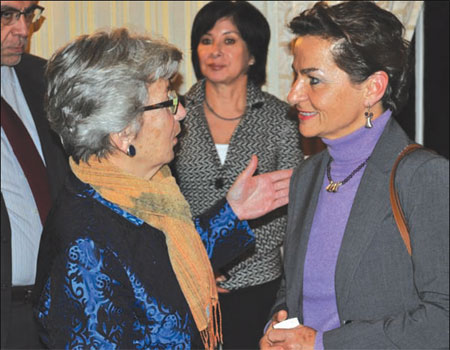
Christiana Figueres (right), executive secretary of the United Nations Framework Convention on Climate Change, chats with Paula DiPerna, special advisor with environmental-data group CDP North America, following Figueres' talk at the Americas Society/Council of the Americas on Tuesday in Manhattan. Michael Barris / China Daily |