Anger over shrine visit
|
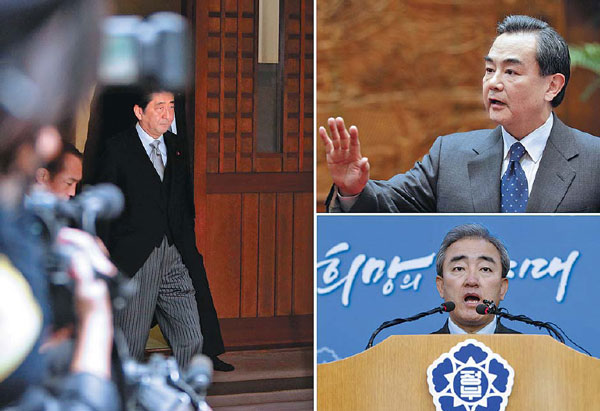
WHAT HAPPENED Left: Japanese Prime Minister Shinzo Abe leaves the controversial Yasukuni Shrine after paying tribute to the war dead, including WWII war criminals, in Tokyo on Thursday. CHINA'S PROTEST Top right: Foreign Minister Wang Yi, who summoned the Japanese ambassador to lodge a protest, says the shrine visit was "a flagrant provocation against international justice and treads arbitrarily on humanity's conscience". SOUTH KOREA'S COMPLAINT Bottom right: South Korean government spokesman and Minister of Culture, Sports and Tourism Yoo Jin-ryong calls Abe's visit deplorable and anachronistic. Left: Yuya Shino / Reuters; Top right: Zhang Wei / China Daily; Bottom right: Park Jim-Hee / Xinhua |
Serious consequences warned after Abe pays war tribute
Shinzo Abe stunned the international community on Thursday by making himself the first sitting Japanese prime minister in seven years to visit a shrine that honors 14 World War II Class A war criminals among the country's war dead.
The abrupt move - widely viewed as rewriting public memory on Japan's militaristic past - enraged Japan's victimized neighbors including China and South Korea and disappointed Japan's traditional ally the United States.
Observers said the hard-core nationalist Abe is ruining the stability of Northeast Asia and that he seems to believe it is worthwhile to sacrifice honesty about history in order to revitalize Japan's assertive style of expansion before World War II.
Foreign Minister Wang Yi summoned Japanese Ambassador to China Masato Kitera to lodge a strong protest on Thursday. Beijing vowed zerotolerance for Abe's touching the bottom of the bilateral relationship, and for betraying the commitment of his government and his predecessors, he said.
Japan must bear "full responsibility for the serious political consequences" of the visit, he said, adding Abe's action has pushed Japan in an "extremely dangerous" direction.
The shrine used to serve as a spiritual tool and symbol of Japanese militaristic aggression, and Abe's pilgrimage is "a flagrant provocation against international justice", Wang said.
South Korean Culture Minister Yoo Jin-ryong said in a statement that "our government cannot repress lamentation and rage over Abe's paying of respects at the Yasukuni shrine, which glorifies its colonial aggression and enshrines war criminals".
A few hours after Abe went to the shrine, the US Embassy in Japan released a written statement saying that "the United States is disappointed that Japan's leadership has taken an action that will exacerbate tensions with Japan's neighbors."
Washington hopes that Japan and its neighbors will "find constructive ways" to deal with sensitive issues from the past, the statement said.
Yang Bojiang, deputy director of the Institute of Japan Studies at the Chinese Academy of Social Sciences, said Abe's visit will deal a heavy blow to Japan's international image and further isolate the country.
"Abe is risking support from within both Japan and the United States, and his political life will come to an earlier end," Yang warned.
Japan has strained its diplomatic relationships with China, South Korea and Russia in the past two years because of disputes over islands and historical issues, and the situation has also been a headache for Washington.
James Fallows, a national correspondent for The Atlantic Monthly, said, "there is almost nothing a Japanese prime minister could have done that would have inflamed tempers more along the Japan-China-South Korea-US axis than to make this visit".
"Americans who visit the 'historical' museum at the shrine (as I have done) will note its portrayal of Japan being "forced" into World War II by US economic and military encirclement," Fallows wrote in his latest online article.
Abe is deliberately stirring up the situation to "make sure the tension does not fade away", said Feng Wei, a professor of Japanese studies at Fudan University in Shanghai.
"Because there will be no more excuses for his plan of revising Japan's pacifist Constitution if there is no tension in Japan's neighborhood," Feng said.
The visit was made as Abe's public support this month dropped to a record low since he retook office last December.
Akihiro Nonaka, a professor at the School of Political Science at Waseda University in Tokyo, said "the enshrining of the Class A criminals is unconstitutional, according to Japan's Supreme Court".
"He does not show respect for the countless Asian people who died in the war," Nonaka added.
Zhou Yongsheng, a professor of Japanese studies at China Foreign Affairs University, said what is behind Abe's pilgrimage is the accelerating pace of the Japanese government in seeking a right-wing style of governing, which is "bringing a huge threat to regional peace".
"As Abe is bent on eliminating all legislative restrictions against Japanese armed forces waging a war, the international community will be unable to rein in Japan from taking such a dangerous step," Zhou warned.