Photos capture moody edge of social change
Yang Fudong's staged photographs often feel like stills from film noir - strikingly dreamlike in the stories they imply. In the series Ms Huang at M Last Night, a lovely young woman and her admirers are depicted in black-and-white in various scenes that emulate the voyeuristic eye of a paparazzo.
"Sometimes I think that pictures are films," Yang says. "That one picture is only one image in a larger story. You can look at both photographs and larger films independently, but for me the most interesting thing is the existence of the image itself."
That series is among an expansive exhibition spanning 20 years of photographs, video installations and films no won display at the University of California, Berkeley Art Museum and Pacific Film Archive. Yang Fudong: Estranged Paradise, Works 1993-2013 is the first mid-career retrospective for the artist, who first shot to prominence with his 2002 film An Estranged Paradise, a meditative psychodrama based loosely on the American director Jim Jarmusch's 1984 film Stranger than Paradise.
|
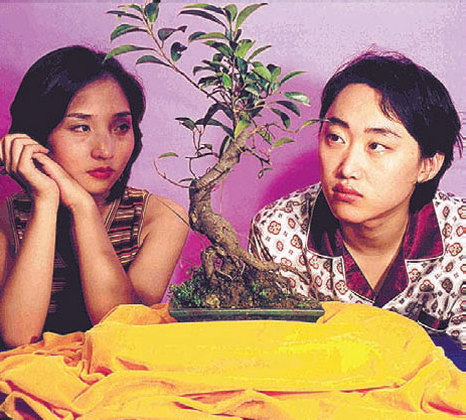
Yang Fudong's works reveal images of the rapdily changing country's anxiety and hope, like this one in The Evergreen Nature of Romantic Stories. Provided to China Daily |
Curated by the Berkeley museum's own Philippe Pirotte and Beatrix Ruf of Switzerland's Kunsthalle Zurich, the exhibition showcases Yang's thoughtful exploration of themes evident in all his work: the interplay between anxiety and indifference, remembering and forgetting, and a mood of discontent he believes to be the mark of a rapidly changing society.
"Yang Fudong's career spans a period of change and brings a powerful artistic perspective to life in China during this momentous era," Pirotte says.
"In particular, Yang's work expresses the aspirations and anxieties of his own generation, born during or just after the 'cultural revolution': unmoored from both traditional culture as well as the guiding principles of Communist orthodoxy, this generation has yet to find its bearings in a culture that celebrates consumerism and rampant growth."
His subjects appear against a changing backdrop, uncertain about the future.
"They tend to be young people in an old country, young people who, in other words, embody a long cultural history while their own experience of life is still relatively fresh," Rey Chow writes in the accompanying catalog.
Yang is unconcerned with political ideology, Pirotte says. His interpretation of avant-garde culture is not presented in contrast or in conflict with the state, but in a choice to define art in relation to society and what he sees as commodity culture, Pirotte writes.
Yang's influences are both Western and deeply Chinese, born of a love of film noir and Chinese cinema from the 1930s and '40s, and still deeply marked by his training as a classical Chinese painter.
"I love Chinese paintings, features, landscapes and architecture," he says. "Everyone has his own place to grow up and residence to live in, and everyone's background and education is different, but a person also needs independent thinking. Sometimes, I contrast my ideals with my reality, and my hopes for the future as a kind of pursuit of real life."
Pirotte believes Yang's work can relate to both Chinese and Western audiences thanks to his comfort in both traditions, he says. Yang's love of film noir will put US viewers at ease, and his many references to traditional Chinese cultural landmarks will do the same for Chinese visitors.
"Yang Fudong suggests collective modes of storytelling, and throws the claims of 'Chineseness' today into a negotiated and shared, open-ended basis of discussion," he says.
"His work brings together the archaic and the contemporary, conciliates documentary and fictional aesthetics, and by doing so invites the audience to look beyond oriental visual display, or 'Chineseness'."