Nation's FDI in US getting more diverse
|
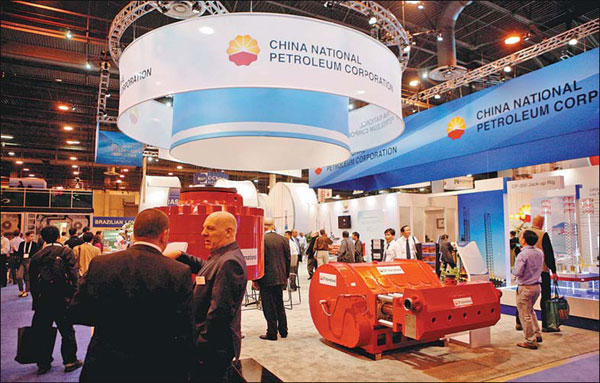
A China National Petroleum Corp stand showcases the company's oil and gas equipment and technology at an offshore technology conference in Houston, Texas. China's investment in the United States is small, accounting for 2.9 percent of its outbound direct investment. Song Qiong / Xinhua |
Although the scope of Chinese investment in the United States is broadening and diversifying, the amounts involved are still a drop in the bucket when it comes to foreign direct investment in the world's largest economy, officials said.
"As of the end of September, Chinese businesses' cumulative direct investment in non-financial sectors in the US accounted for 2.9 percent of China's total outward direct investment, which wasn't in line with the huge markets in both countries," said Wang Chao, vice-minister of commerce, during the High-Level Forum (Beijing) on Sino-US Investment Promotion on Friday.
In terms of the number of investments, mergers and acquisitions and greenfield investments (new projects built from the ground up) were evenly divided.
But M&A deals accounted for 80 percent of the total value, with greenfield projects taking up just 20 percent, according to Wang Xu, deputy director-general of American and Oceanian affairs at the Ministry of Commerce.
"Chinese investors are more interested in buying companies than establishing companies in the US," said Wang.
State-owned enterprises are more active in the US than private companies. In terms of sectors, manufacturing is still the most prominent, Wang added.
However, as the two economies are highly complementary in terms of resources, markets, funds and technology, they are increasingly relying on each other for development.
"The two countries have different industrial structures and different positions in the global value chain. The US is at the top end, while China sits at the middle or even low end," said Wang.
New trends in Chinese investment in the US are emerging. Investors' goals are evolving from accessing resources and market share to branding and technology acquisition and consolidating value chains.
"The situation shows that Chinese businesses are more mature," Wang said.
Bilateral trade is also changing, moving beyond merchandise trade to all economic sectors.
Since the two countries established diplomatic relations in 1979, the US has invested in more than 63,000 projects in China, with paid-in investment of $72.6 billion as of Sept 30.
China's cumulative direct investment in non-financial sectors in the US exceeded $10 billion in the same period, according to Wang, the vice-minister.
"With huge markets, vast technology and sound infrastructure, the US holds great attraction for Chinese investors, and Chinese businesses have improved their management and expertise by investing in the US," he added.
Still, the vice-minister noted increasing friction in bilateral relations and the resistance Chinese investors have met in the US.
He said that the US government should give fair treatment to Chinese businesses, including State-owned enterprises.
William Zarit, minister counselor for commercial affairs at the US embassy in Beijing, said that Chinese direct investment is vital to the US' economic growth, job creation and productivity.
"Recent notable Chinese investments reflect a very broad range of sectors, including shale gas, real estate, technology, food processing and the media," Zarit said.
He said that the US offers a good business environment, where intellectual property is protected and the predictable legal system resolves disputes quickly.
Also, as a result of free trade agreements the US has reached with many countries, Chinese products manufactured in the US can be exported duty-free to global markets.
"Energy costs in the US are among the least expensive in the world," said Zarit.
As for Chinese companies' concerns over investments blocked for national security reasons, Zarit said that most transactions that don't have any national security implications aren't being reviewed.
"Companies always encounter difficulties in fresh markets, especially since each of our 50 states has different tax structures, regulatory systems and even financial incentives for foreign investment," Zarit said.
He suggested that Chinese companies take advantage of the expertise provided by law firms, investment banks and public relation firms to improve their chances of success in the US.